

Host a Fabulous Bouquet Bar for Valentine's Day
How to host a fresh flower or bouquet bar.

Winter is the perfect time to host or plan a Bouquet Bar as the highlight of your next special event. Bridal and baby showers seem to be the most popular choices for flower fun, but you can host a Bouquet Bar anytime you want. Girlfriend getaways, book club nights, and birthday and dinner parties lend themselves nicely because no matter the occasion, everyone loves going home with fresh flowers. So since Valentine’s Day is coming up, why not invite some friends over to build pretty bouquets?
Should I D-I-Y My Bouquet Bar?
You can hire a professional to create your bouquet bar or you can D-I-Y it by following these easy steps. If you prefer this option, a professional will bring everything to your site, set up, instruct, and clean up. But if you choose to do it yourself, you only need a few things to pull off a successful bar, the most important being a reliable source of some great focal flowers and foliage.
Here is a list of everything you will need:
• A work table for guests to spread out
• A reliable water source (a sink or hose)
• Tablecloths and towels
• Vases or pretty water-tight pots for assembly
• Flower Buckets to display your greens & flowers
• Fresh Flowers and Greens
• Paper goods for refreshments

Prepare the Space
You can create your bouquet bar anywhere that works. Dining rooms, kitchens, patios, decks. Just make sure you have a source of water nearby and that cleanup will not be too difficult. If you’re creating a Bouquet Bar at work, you will probably want to choose a conference room because it will have a lot of space.
Find a good area and set up enough tablespace for everyone to work comfortably. The Bouquet Bar above hosted 11 people and the instructor. This was created in an average-sized dining room. We first placed the tablecloth and each participant received a paper towel. For a more formal party, you can also supply your guests with cloth towels and give them as favors after the event.
Tools and Vessels
It’s important to provide each guest with flower snips or sharp scissors because they will each want to trim their stems and you don’t want everyone reaching around the table sharing snips. You can buy multipacks of scissors or invest in better-quality garden snips that your guests can take home. This will depend on the size of your party and/or occasion.
As for the vessel, I always like to choose a short opaque pot that is water-tight. I think this shape and size above work well for creating an arrangement. But you can always provide tall vases if large and tall arrangements are your preference. I try to avoid clear glass only because I like it when the stems are concealed. The vessels in the photo were purchased at Michaels.

Flower Buckets for Display
Choosing your flower and foliage display buckets is a simple way to “theme up” your event. There are many buckets to choose from including a chippy farmhouse french style, formal basic black, or industrial galvanized metal. Set the buckets up on a covered buffet table or an extra folding table, and be sure to style it according to your theme.
Flowers and Foliage
In the winter months you’ll want to contact a wholesaler if you can so that you can get larger quantities to fill your display buckets. In the spring, summer and fall months I’d find a local flower farm or two and purchase your flowers from them. They will be the best quality and the growers will appreciate your business.
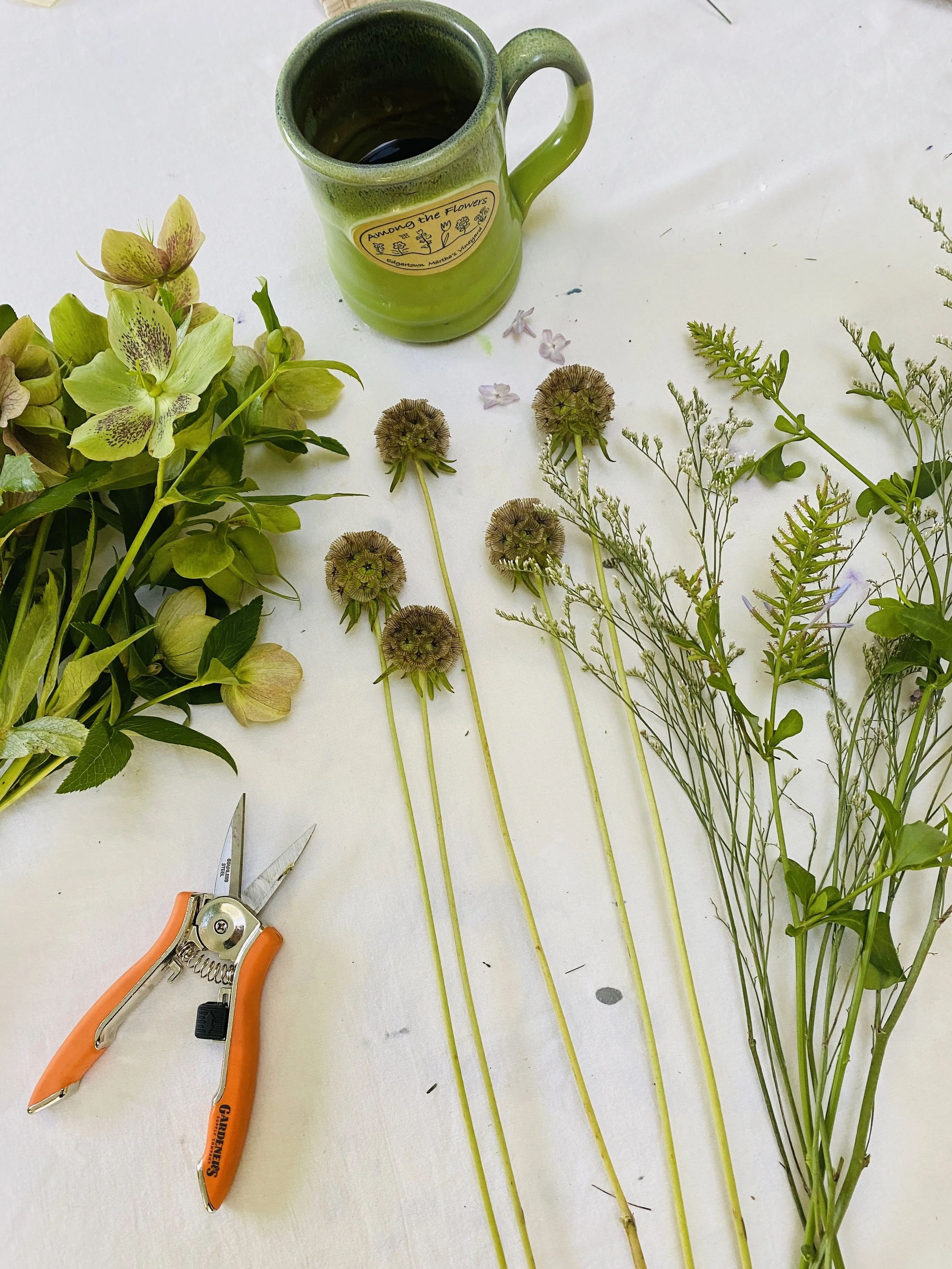
How Many Do I Buy?
Counting stems is a critical part of all of this planning. I always overbuy my flowers because I’d rather have too many than not enough. It’s a good idea to purchase an extra vessel and do a dry run arrangement with some flowers and greens. Then take it apart and count how many foliage and flower stems you used. Triple that and multiply it by the number of guests. You’ll want to have a nice variety to choose from and if you have too few of something, some arrangements may seem sparse. And remember, flowers do break in transit, during processing, and when Bouquet Bar enthusiasts get TOO ENTHUSIASTIC. So be sure to order more than you’ll need. You’ll be happy you did.
Focal flowers, filler flowers (the secondary flowers, not the primary focus) and foliage (the greens) are generally all sold in bunches of 10, so if you want only one type of focal flower, choose only that. But if you want your guests to have choices, then split up your order and buy a variety of flowers. Popular ideas for foliage and filler flowers are eucalyptus, asparagus fern, and wax flower.
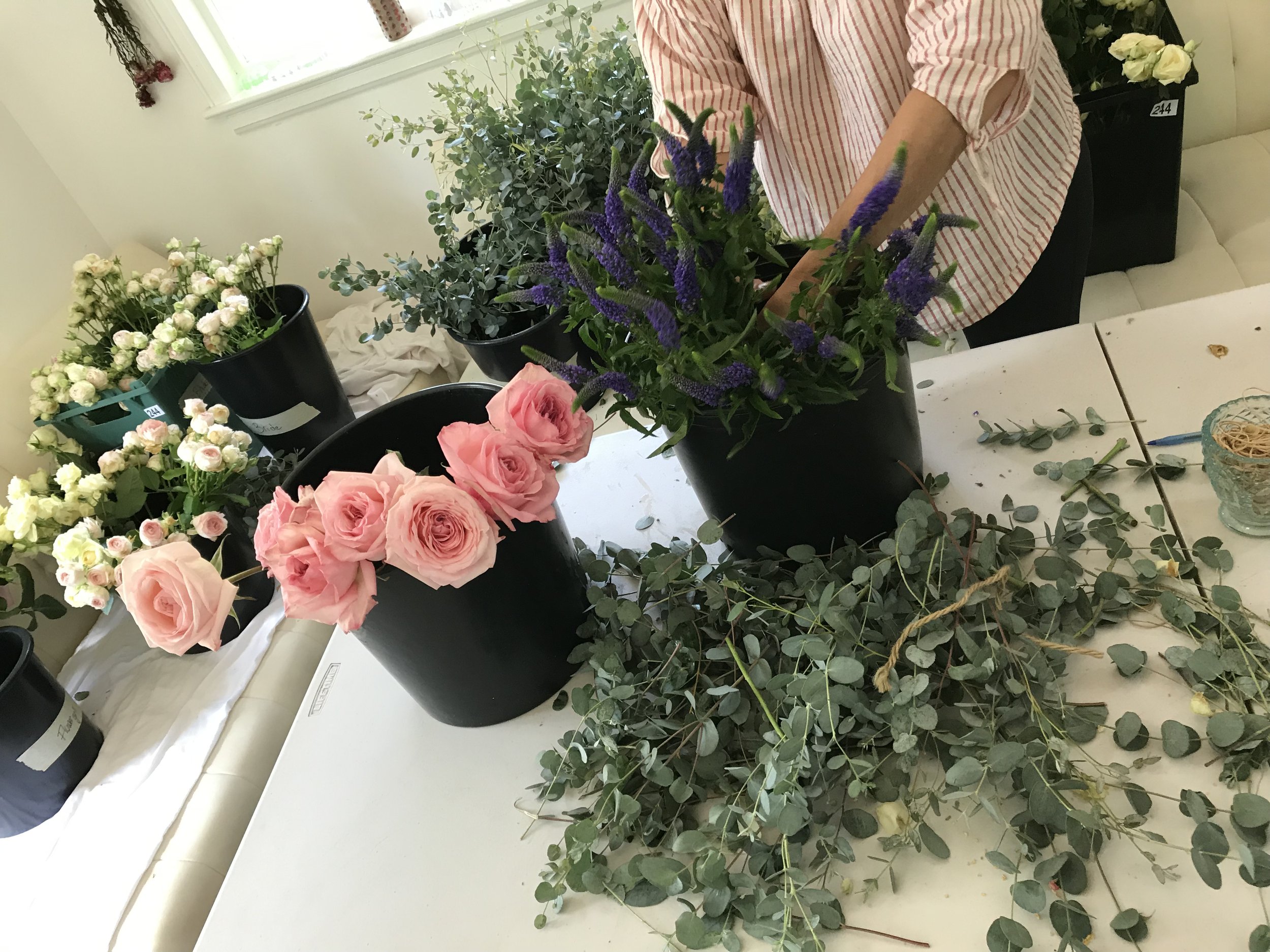
Preparing the Flowers
The day before your event, you’ll need to process all the flowers and greenery. This means, taking all the bunches out of the paper or plastic, cleaning and trimming each stem before placing it in fresh cold water with flower food. This is a good time to divide up and organize your buckets so that everything looks well-displayed.
Before trimming the bottom of each stem so that it comfortably fits into its bucket, thoroughly strip each stem of any extra greens or thorns so that leaves do not touch the water. Then store all of your buckets in a cool, dry place overnight. This step is important, as it allows the flowers and foliage to fully hydrate before becoming part of an arrangement and if you are working with tulips, they will stay closed if the space is cool and dark. Proper hydration, allows your arrangements to stay fresher longer.

Day of Event
On the day of the event, style your flower buckets any way you like. You can scatter them around the room or patio, offering different heights for interest but try to keep like things together. For instance, foliage can be in one area, focals in another. Then, set up your guest’s work table and fill each vessel halfway with water.
When the guests arrive, put on some music, explain the bouquet bar, and instruct them to consider what sort of bouquet they’d like to create.

You’ll be creating with your guests so show them how to first choose 5-7 stems of foliage (depending on the size of the vessel) to arrange as a base. Once the foliage is cut and designed in each vessel, point your guests in the direction of the filler flowers. Once the filler and foliage are styled to everyone’s tastes, have your guests choose 3, 5, or 7 focal flowers to round out their bouquet. Do not forget to stage a photo which can serve as a nice thank-you note after the event.
Bouquet Bars are always a big hit so I hope you were inspired by this post and comment about your own experiences. Thank you for visiting.

Thank you, Ileana, for the use of your photos.

Why Choose Seasonal Flowers for Your Special Occasion?
Did you know there is such a thing as a seasonal flower? Much the way there is seasonal food, there are seasonal flowers and the same principles apply.

Seasonal Flowers
Did you know there is such a thing as a seasonal flower? Much the way there is seasonal food, there are seasonal flowers and the same principles apply. Tomatoes are much better when they come directly from your garden and are grown in warm weather months. Flowers are no different. Depending on your region, the seasonal timeline may vary slightly, but for the most part, we all follow similar growing guidelines.
Fresh seasonal flowers will last at least one week in a vase of clean water, and if processed correctly, many can last much longer. But a cut flower that spends the majority of its life on hold in a dark cooler at the wholesaler, after having endured long days of travel, just won't last as long or be quite as beautiful. This is just one of the many reasons to choose more local and seasonal flowers whenever possible.
The American Flower Farmer
Florists who prefer to primarily use in-season flowers and foliage are usually located in areas with predictable weather patterns. If the weather is too cold for too long, the growing season is just too short for the local flower farmers to make any headway. Many annual cut flowers used by florists require warmer weather for several months at a time. Predictable warm climates are one of the reasons much of the flower-growing industry migrated to South America and Mexico many years ago. However, changes in recent years, with the introduction of the Slow Flower Movement indicate that The American Flower Farmer is making a comeback. Choosing to support locals the next time you seek a fresh bouquet of flowers is an excellent way to ensure they stay. I have included links at the bottom so you can access books and watch two short videos about the Slow Flower Movement in America. The informative book, Flower Confidential., was recommended to me at the beginning of my flower journey and I recommend reading it if you want to learn more about the flower industry in general.
Choosing A Season For Your Event
Proms begin in early spring so that places them at a good time of year to request seasonal flowers. Spring flowers are usually plentiful in many regions of the United States. Mother's Day is also in spring, making it an easy holiday to give a seasonal flower bouquet. Valentine's Day and Winter Holidays, not so much, however, I happen to know many local eco-conscious growers not afraid of the concept of traditional flower substitutions - for instance, opting for locally-grown tulips when only non-domestic roses are the winter alternative. Or you can always do what I do and search for a flower grower in another part of the United States with longer seasons where you can source flowers. Did you know that Alaska has many peony farms and that they are readily available to us outside of our limited growing season? And California with its mild climate and longer growing season has an abundance of flower growers ready to ship upon request. The prom below was in early spring and I chose pink tulips as the posy accent flower.

Prom Flowers
Seasonal wedding flowers are a little easier to manage. Choosing the season of your wedding day based on season-based availability is something you have total control over and one way to creatively plan the beauty of your bouquet and other accents. Asking your sustainable flower artist to source American Grown Flowers and following color schemes rather than specific flowers are both good practices if you choose to have a more eco-conscious wedding. The wedding below took place in early October and the couple chose to use Dahlia.

Photography by Karma Pants
Growing Zones
Spring flowers seem to pop up just in time here in the Northeast U.S. where I reside. At the end of March, we are all ready to shed the coats and get outside for some much-needed vitamin D and that's just the time these beautiful little lovelies begin emerging from the ground. My zone in Pennsylvania is 7b. You can find your zone here. Zone growing guides will help you understand what types of flowers are growing in your area of the country. This will help you plan for a seasonally sourced event.
Spring
The most popular spring flowers in this area are what are known as perennials. A perennial plant or shrub is a plant that lives for more than two years, however, many flower growers and garden lovers treat common flowers like narcissus and tulips as annuals and plant new bulbs every single fall to ensure they will be viable in the spring. Spring flowers tend to be abundant everywhere you look and they are a nice reminder that the winter is over and the season is changing.

Spring Narcissus at Windy Hill Farm. Photography by Kim Bensing
The Transition
At the very end of spring and the very beginning of summer, there is sometimes a slight lull in the season of flowers. Just as the spring perennials are dying off and the new annuals are just going into the ground, there is a period of time when local flowers are somewhat limited. Ironically, this seems to be the most popular season for brides. The weather is nice but the next season of flowers is not quite ready. So if you are a bride planning a wedding and you definitely want to use eco-friendly seasonals, I recommend choosing a different time of the year so that you have an abundance of seasonals to choose from.
Summer
The summer months are by far the most prolific flower-growing months in the United States. It's true that annual cutting flowers are planted every year by enthusiasts, but a great many of the early summer perennials will repeat perfectly year after year without much tending. Some of the summer perennials may require separation after several years just to thin things out, but I've also gone many years just enjoying the varieties on my farm and leaving them to themselves.

Summer Annual Flowers at Detweiler Homestead Farm
By mid-late summer the many cut flower annuals planted in the northeast in mid-May start to become available for harvest. These annuals are a huge part of the local flower growers' economy. Farmers' markets and roadside stands are bursting with buckets of fresh blooms and it's a much more sustainable way to enjoy a simple weekly bouquet.
Autumn
In early autumn we still have the wonderful late summer flowers going strong, and we are starting to see some blooms from the autumn group. Sunflowers are abundant at this time of year and a very popular flower in autumn is the Dahlia. If you are unfamiliar with the Dahlia, try to find a grower in your area and purchase a few. You will be amazed at the wide range of colors these fall flowers provide. Floral designers just love them because of all their vibrant colors, these colorful blooms create attractive floral arrangements and beautiful bouquets without much assistance.

Dahlia Detail. Photography by Kim Bensing
Winter
While it's true, the cooler months produce fewer flowers this by no means diminishes amazing seasonal possibilities. There is so much out there if you pay close attention and search. Think of all of the forever reliable evergreen shrubs, twigs, berries, and pine cones which are rigid seed vessels but beautiful and useful nevertheless. Winter varieties are vast and can be just as interesting if that is your season of choice.
Below I have provided a few short lists of some seasonal flowers that are pretty universal in the Northeast. Enjoy learning about how flowers, like our food, are seasonal and why it's important to know and appreciate their bloom cycles when planning your special events. Thank you for reading about seasonal flowers. Please share your favorite season of flowers in the comments below.

Winter Wreath design by Amber of Rising Hill Farm
Popular Spring Flowers:
Narcissus
Tulips
Hellebores
Lily of the Valley
Hyacinth
Forsythia
Cherry Blossoms
Peonies
Popular Early-Mid Summer Flowers:
Peonies
Astilbe
Clematis
Oriental Poppies
Iris
Lavender
Popular Mid-Late Summer Flowers:
Echinacea
Sunflowers
Rudbeckia
Phlox
Shasta Daisies
All the Annual Cut Flowers
Popular Autumn Flowers:
Dahlia
Sunflowers
Chrysanthemums
Celosia
Asters
Dianthus
Popular Winter Choices:
Cedar
White Pine
Concolor Fir
Arborvitae
Boxwood
Juniper
Winterberry
Snowberry
Cones
Curly Willow
Learn more about this topic.
Watch these videos:
American Growers: Local Flowers, Local Farmers: A Growing Movement
What Is The Slow Flower Movement?
Enjoy These Books:


Hi, I’m Kim. Welcome to Studio Sprig.
Kim Bensing’s original watercolors and designs are now available on wallpaper and fabric. To order visit Studio Sprig’s design library on Spoonflower. Contact me if you need assistance.
-
EVENTS
22
- Oct 23, 2026 Wrapped in Wonder: The Art of Giving a Gift Oct 23, 2026
- Sep 26, 2026 Homecoming Flowers: A Beautiful Tradition Then and Now Sep 26, 2026
- Sep 23, 2026 Choose Wedding Flowers With Meaning: How to Create a Bouquet That Tells Your Love Story Sep 23, 2026
- Sep 21, 2026 The Pre-Prom Tradition Every Mom Should Try: Host a Backyard Bouquet Party Sep 21, 2026
- Sep 18, 2026 Lambertville’s Halloween Magic: A Funky, Creative Rivertown Comes Alive Sep 18, 2026
- Aug 20, 2026 How to Host a Beautiful Flower Bar: The Ultimate DIY Flower Bar Party Guide Aug 20, 2026
- Aug 19, 2026 How to Decorate Cakes with Fresh Flowers: Floral Wreaths, Crowns & More Aug 19, 2026
- Aug 19, 2026 Decorating Cakes with Fresh Flowers Aug 19, 2026
- May 18, 2025 How to Make DIY Bouquets for Prom May 18, 2025
- May 7, 2025 How to Preserve and Use Your Spring Flowers - All Year Long May 7, 2025
- Feb 27, 2025 Get Excited for The Flower Show Feb 27, 2025
- Feb 14, 2025 Historic Castles. What are they used for? Feb 14, 2025
- Jan 31, 2025 Creative Ideas For Your Valentine Jan 31, 2025
- Jan 28, 2025 How An Invitation Can Tell Your Love Story Jan 28, 2025
- Jan 23, 2025 How to Design a Valentine Tree Jan 23, 2025
- Jan 16, 2025 Host a Fabulous Bouquet Bar for Valentine's Day Jan 16, 2025
- Apr 4, 2023 Why Choose Seasonal Flowers for Your Special Occasion? Apr 4, 2023
- Feb 1, 2023 10 Ideas for an Eco-Friendly Event or Wedding Feb 1, 2023
- Nov 14, 2022 A Family Tree Inspired Wedding Invitation Nov 14, 2022
- Oct 3, 2022 How to choose flowers that have sentimental meaning Oct 3, 2022
- Nov 9, 2020 Simplified Wedding Ceremony during Covid Nov 9, 2020
- Apr 2, 2019 Why You Should Choose Seasonal Prom Flowers Apr 2, 2019
-
HOME
23
- Sep 9, 2026 How to Name a Farm: 10 Meaningful Ideas for Creating a Name With a Story Sep 9, 2026
- Sep 1, 2026 How to Preserve Flowers for Creative Projects Sep 1, 2026
- Jul 2, 2026 How to make your own flower confetti Jul 2, 2026
- Apr 22, 2025 How We Painted our Barn Apr 22, 2025
- Apr 16, 2025 What to Plant for Mesmerizing Spring Blooms Apr 16, 2025
- Apr 8, 2025 Narcissus AKA Daffodil - What's Blooming at Studio Sprig Apr 8, 2025
- Apr 1, 2025 Glory-of-the-Snow - What's Blooming at Studio Sprig Apr 1, 2025
- Mar 19, 2025 How we turned an Artist Studio into a Weekend Retreat Mar 19, 2025
- Mar 12, 2025 The Mighty Crocus - First to Bloom - What's Blooming at Studio Sprig Mar 12, 2025
- Jan 23, 2025 How to Design a Valentine Tree Jan 23, 2025
- Jan 16, 2025 Host a Fabulous Bouquet Bar for Valentine's Day Jan 16, 2025
- Jan 9, 2025 How to Make Your Own Mint Tea Jan 9, 2025
- Jan 7, 2025 How To Create A Courtyard Jan 7, 2025
- Jan 2, 2025 How to Create a Stunning Centerpiece Jan 2, 2025
- Mar 27, 2023 How We Transformed Our Farmhouse Kitchen by Reusing, Updating, and Thrifting: (Coffee Bar) Mar 27, 2023
- Mar 27, 2023 How We Transformed Our Farmhouse Kitchen by Reusing, Updating, and Thrifting Mar 27, 2023
- Mar 1, 2023 How and Why We Love Historic Homes Mar 1, 2023
- Jan 3, 2023 Eliminate Sneaky Sugars Jan 3, 2023
- Dec 14, 2022 How to Create a Pretty Mini Bar with Items You Already Own Dec 14, 2022
- Nov 21, 2022 Friendsgiving At Our Farm Nov 21, 2022
- Nov 9, 2022 Herbs: How to Grow, Harvest and Dry Your Own Nov 9, 2022
- Nov 9, 2022 DIY Herb Drying Rack: Herb Drying at Home Nov 9, 2022
- Oct 12, 2022 Have you ever thought about creating a beautiful water feature? Oct 12, 2022
-
STYLE
27
- Oct 6, 2026 Where Flowers Become Art, Experiences & Memories Oct 6, 2026
- Sep 1, 2026 How to Preserve Flowers for Creative Projects Sep 1, 2026
- Aug 20, 2026 How to Host a Beautiful Flower Bar: The Ultimate DIY Flower Bar Party Guide Aug 20, 2026
- Aug 19, 2026 How to Decorate Cakes with Fresh Flowers: Floral Wreaths, Crowns & More Aug 19, 2026
- Aug 19, 2026 Decorating Cakes with Fresh Flowers Aug 19, 2026
- Jul 2, 2026 How to make your own flower confetti Jul 2, 2026
- Nov 3, 2025 Creating a Pressed Flower Frame Nov 3, 2025
- May 7, 2025 How to Preserve and Use Your Spring Flowers - All Year Long May 7, 2025
- Jan 28, 2025 How An Invitation Can Tell Your Love Story Jan 28, 2025
- Jan 23, 2025 How to Design a Valentine Tree Jan 23, 2025
- Jan 6, 2025 How to Create Oyster Shell Necklaces Jan 6, 2025
- Jan 2, 2025 How to Create a Stunning Centerpiece Jan 2, 2025
- Mar 14, 2023 How to Make Sentimental Easter Eggs Mar 14, 2023
- Mar 6, 2023 How to Enjoy The PHS Philadelphia Flower Show Mar 6, 2023
- Feb 13, 2023 Let's Save The Bees Feb 13, 2023
- Feb 1, 2023 10 Ideas for an Eco-Friendly Event or Wedding Feb 1, 2023
- Jan 12, 2023 A Great Way to Help Kids with Cancer (PENN STATE) Jan 12, 2023
- Dec 14, 2022 How to Create a Pretty Mini Bar with Items You Already Own Dec 14, 2022
- Nov 29, 2022 Lunch and Dinner -Studio Sprig Style Micro Blog Nov 29, 2022
- Nov 14, 2022 A Family Tree Inspired Wedding Invitation Nov 14, 2022
- Nov 9, 2022 DIY Herb Drying Rack: Herb Drying at Home Nov 9, 2022
- Oct 30, 2022 Lambertville, Nj , A Funky, Cool Rivertown You Must Visit on Halloween. Oct 30, 2022
- Oct 19, 2022 How to choose an interesting place to stay when you travel or go on vacation Oct 19, 2022
- Oct 12, 2022 Have you ever thought about creating a beautiful water feature? Oct 12, 2022
- Oct 3, 2022 How to choose flowers that have sentimental meaning Oct 3, 2022
- Feb 1, 2021 How to design marketing materials for your small business Feb 1, 2021
- Oct 29, 2020 Surprise the bride when you can't come to her wedding Oct 29, 2020