

How to Name a Farm: 10 Meaningful Ideas for Creating a Name With a Story
How to Name A Farm -how we named our farm in Bucks County Pennsylvania, Windy Hill Farm after the book The Ghost of Windy Hill.
Choosing a farm name can be one of the most personal parts of making a place your own. The best farm names often come from somewhere real—a family story, the land itself, a favorite memory, an old photograph, or even a beloved book. Here's how I found the perfect name for our historic Pennsylvania farmhouse—and how you can find a meaningful name for yours. A Treasured Storybook
Start With the Story Behind Your Farm
When we decided to name our farm, I didn't want a name that simply sounded pretty. I wanted something that had meaning.
Our farmhouse is located in historic Bucks County, Pennsylvania, surrounded by old farms, stone houses, and beautiful countryside. We moved here in 2007, after our family outgrew our first historic home.
The house we found was a wonderful old clapboard farmhouse with a wrap-around porch, a barn, enormous trees, and plenty of history.
But as much as I loved the property, it didn't have a name.
So, naturally, I decided it needed one.

Front View Windy Hill Farm. Photo courtesy of Kim Bensing Design.
How Do You Choose a Farm Name?
If you're wondering how to name a farm, start by looking around you.
Before making a long list of clever farm names, look for the stories that already exist on your property.
Ask yourself:
What is the history of the land?
Who lived here before you?
Is there an interesting family name connected to the property?
What natural features surround the farm?
Is your farm on a hill, beside a creek, in a valley, or near a particular grove of trees?
Are there old barns, stone walls, gardens or outbuildings?
What animals, flowers or crops are special to the property?
Is there a favorite childhood memory associated with the land?
Are there old photographs, maps, letters or documents that might reveal something?
Is there a book, song or story that has a personal connection to your family?
Sometimes the best farm name ideas aren't invented at all. They're discovered.

Windy Hill’s wrap-around balcony is not original to the farmhouse. We think it was added sometime in the early 1980s. It’s very nice and provides a great place to catch 9 simultaneous fireworks shows on the 4th of July.
Look to the Land for Farm Name Ideas
The landscape itself can be a wonderful source of inspiration.
Think about words that describe your property:
Hill • Hollow • Meadow • Grove • Creek • Brook • Orchard • Field • Valley • Ridge • Woods • Garden • Acres • Farm
You can combine these with something personal.
For example:
Willow Hill Farm
Fox Hollow Farm
Meadow Grove
Old Oak Farm
Windy Hill Farm
Rose Hill
Bluebird Farm
Orchard House
A good farm name doesn't necessarily need to explain everything about the property. Sometimes one evocative word is enough to create a feeling.

Snow covered little Cottage at Windy Hill Farm. Photo courtesy of Kim Bensing Design.
Look Into Your Farm's History
If you own an older property, spend some time investigating its past before choosing a name.
Old deeds, maps, photographs, newspapers and family records can reveal fascinating clues.
And don't overlook your neighbors.
Someone who has lived in the area for decades may know something about your property that you could never find online.
That's exactly what happened to us.

Walpole Lamppost and sign created by McElHaney Signs here in town.
The Story Behind Windy Hill Farm
For years, I had owned a little vintage children's storybook called The Ghost of Windy Hill.
It was one of my favorite weekly readers as a child, and somehow that little book stayed on my bookshelf throughout my entire life.
The book was written in 1966—the same year I was born—and the story takes place in 1851, around the same era our farmhouse was built.
I had never imagined that the book would eventually inspire the name of our home.
But then we discovered something about the property.
Our farmhouse sits at the top of a ridge, surrounded by enormous old trees. The wind moves through the property constantly, whistling through the original windows and across the hill.
When it gets windy here, it gets really windy.
Suddenly, the name seemed obvious.

Windy Hill’s side view with a big old tree. Photo courtesy of Kim Bensing Design
Windy Hill.
The old storybook gave the name a personal history, while the land itself gave it meaning.
And just like that, our farm had a name.

View of Windy Hill’s Barn behind a lilac. Photo courtesy of John Arehart Photography.
Sometimes the History Finds You
After we named the property Windy Hill, something unexpected began happening.
People started stopping by.
Over the years, approximately twenty people have told us that they had once lived in the house, visited the property or spent time in the old barn.
Then one summer day, an older woman named Dee and her daughter stopped by.
Dee told us that she and her cousin had spent summers here during the 1930s. The farm had belonged to their aunt and uncle, and the property held some of her favorite childhood memories.
A week later, Dee returned with her cousin.
They brought old photographs.
They showed us pictures of the property from decades earlier and even brought a hand-drawn floor plan of the house.
As we walked through the rooms together, they remembered where old doorways had been and explained why certain parts of the house seemed unusual.
Then Dee's cousin stopped before what is now our dining room.
He said there had once been a large hole in the floor for the heat.
We had always known there was something unusual about the floorboards, but we had never understood why.
Sure enough, there was a covered opening exactly where he remembered it.
It was one of those moments when a house stops being simply a house.
It becomes a story.

Dee, her daughter, her cousin, Kim & Mike Bensing.
Meaningful Farm Names Often Come From the Past
That experience changed the way I think about naming a property.
A farm name doesn't have to be clever.
It doesn't have to follow a trend.
And it doesn't have to be something you come up with in one afternoon.
The most memorable farm names with meaning often connect the present to the past.
Your perfect name might be hiding in:
An old family photograph
A childhood book
The name of a former owner
A nearby landmark
A favorite tree
A creek or hill
An old field name
A family tradition
A local legend
The history of the property
A meaningful event that happened there

How to Choose the Right Farm Name
Once you've gathered your ideas, make a short list.
Then say each name out loud.
Does it feel natural?
Is it easy to remember?
Can people spell it?
Will it still make sense if your farm changes or grows?
And most importantly:
Does the name mean something to you?
A good farm name should feel like it belongs to the land.
You don't necessarily need the most unique name. You need the name that feels right.

Dining Room Floorboards at Windy Hill Farm.
Give Your Farm a Name That Can Become Part of Its History
After choosing Windy Hill, we installed a beautiful lamppost and sign at the entrance to the property.
That little sign became more than decoration.
It gave our home an identity.
Over the years, it has become part of the story of this place—and now, whenever someone asks where we live, I can simply say:
Windy Hill.
And somehow, that says so much more than an address ever could.
If you're trying to name your own farm, farmhouse, homestead or historic property, look for the story before you look for the name.
You may discover that the perfect name has been there all along.

Historic Images of Windy Hill Farm circa 1930s.
More Studio Sprig Inspiration
If you love historic homes, gardens, flowers and the stories behind beautiful places, explore more of Studio Sprig's floral art, surface patterns and inspiration from Windy Hill Farm.
And if your property has a story of its own, I'd love to hear it.
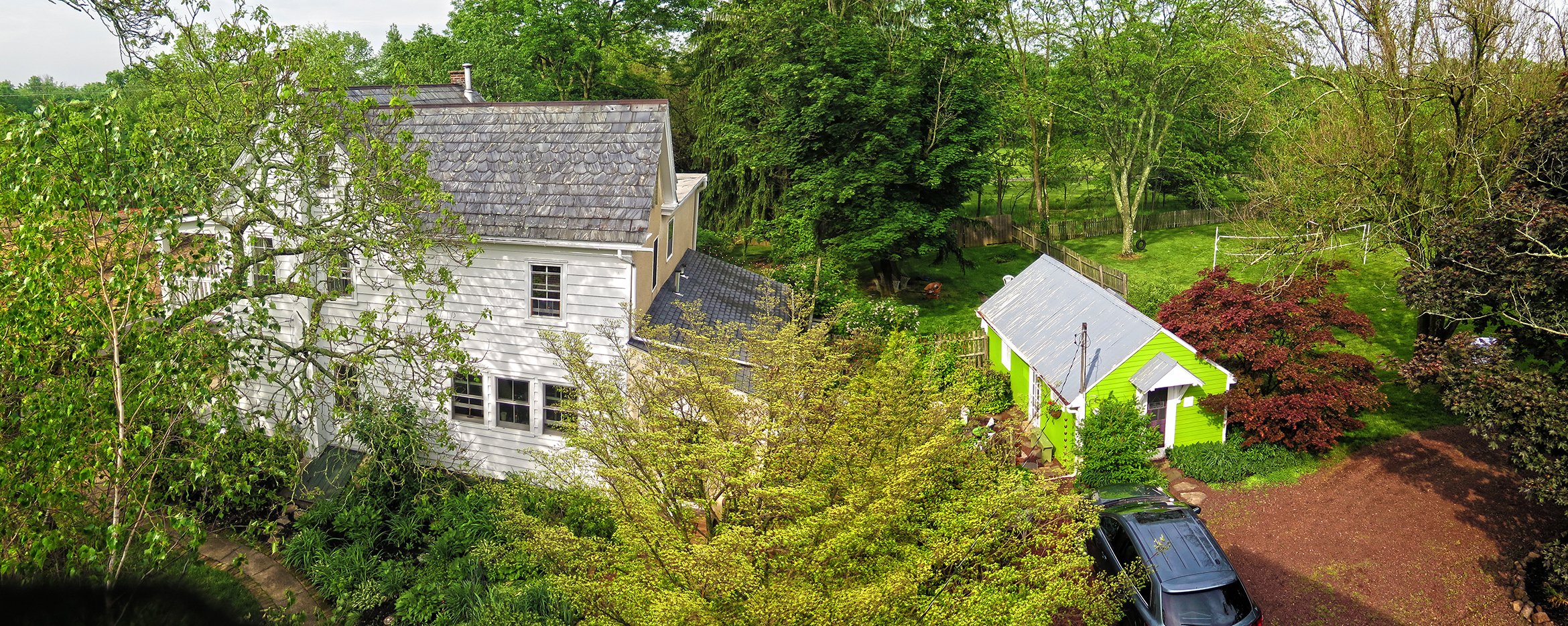
View of Property from the Barn. Photo courtesy of John Arehart Photography.
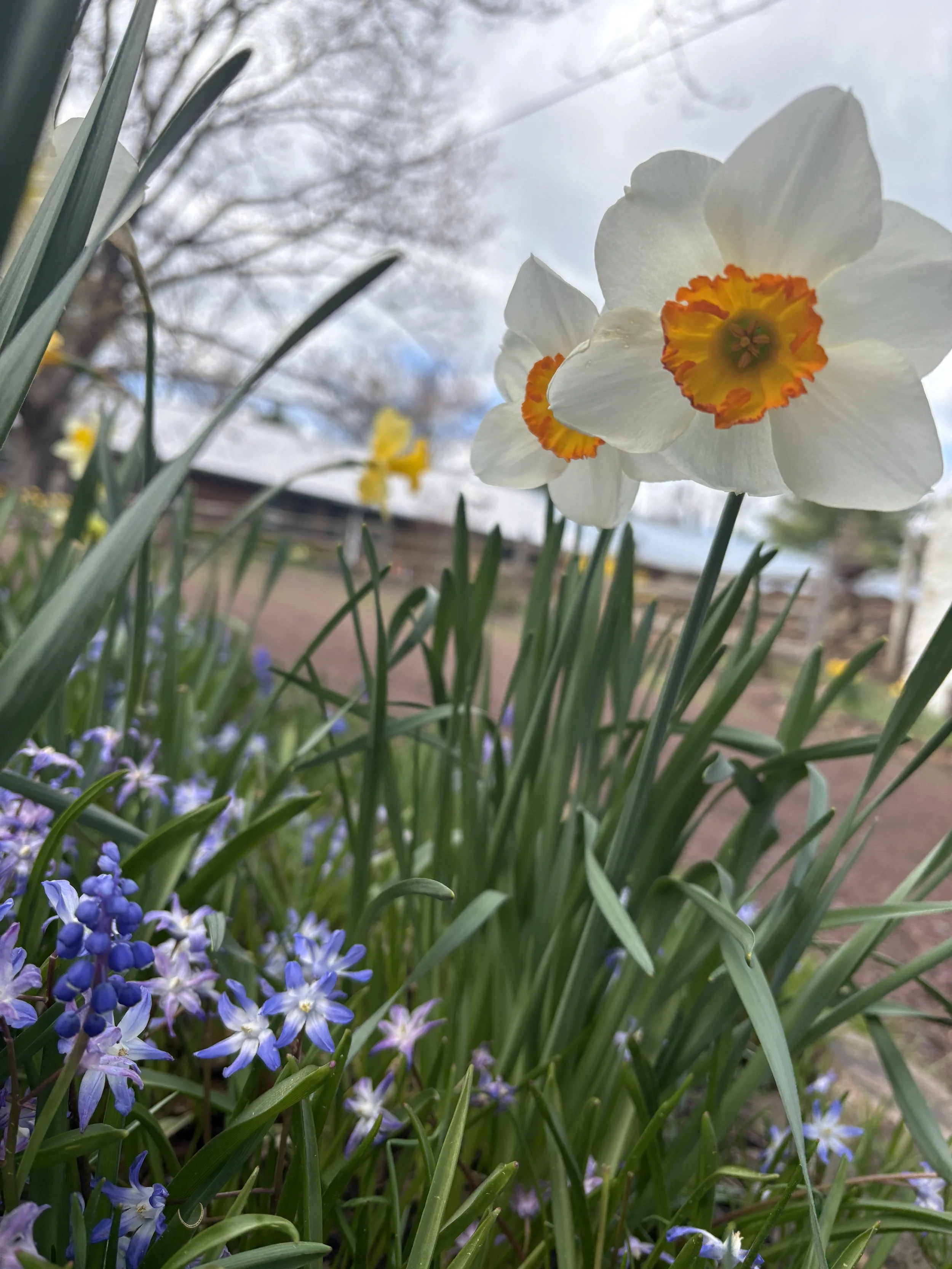
Narcissus AKA Daffodil - What's Blooming at Studio Sprig
These flowers seem to pop up everywhere in early spring. They’ve become a very popular bulb to plant in autumn and I always look forward to seeing them on cold, chilly, April mornings at Windy Hill in Pennsylvania.

Almost everyone is familiar with the common Daffodil, whose scientific name is Narcissus. These flowers seem to pop up everywhere in early spring. They’ve become a very popular bulb to plant in autumn and I always look forward to seeing them on cold, chilly, April mornings at Windy Hill in Pennsylvania.
what’s interesting about this common flower?
You may not know that the name Narcissus comes from a Greek myth about a handsome youth who fell in love with his reflection in a pool of water. He was so obsessed with his reflection that he tried to grab it and fell to his death. When Daffodils sprung up on that site, they were named Narcissus in remembrance of the boy. Fun stuff.

So diverse
Narcissus is a diverse genus with over 50 species of flowering plants, including daffodils, jonquils, and paperwhites. They are a bulbous, perennial plant which means you’ll see them year after year. They also naturalize very well, meaning they will spread around to other areas of your garden if you want them to. I always leave my daffodil bulbs in the ground and each year I see more and more. Here are a few varieties growing on our farm.


Did you know?
Historical texts and archaeological digs reveal that daffodils were cultivated by the ancient Greeks and Romans, who believed that the sap from daffodil bulbs contained healing powers. This belief carried into medieval Europe, where daffodils were used in various remedies. As interesting as that is, they are also very toxic.

Toxicity
All parts of the narcissus plant are toxic if ingested, especially the bulb. They can cause skin irritation, nausea, vomiting, and even death in extreme cases. Keep them away from children and pets. Likewise, when placing stems in water, it’s best to separate daffodils from other cut flowers, as they could poison the vase.
On The Bright Side
Daffodils are the official 10th wedding anniversary flower and it is also the national flower of Wales. You can read more about that here. I have included some Narcissus links for your convenience. If you are not already growing some, please give them a try. Thanks for visiting, come again. - Kim

Yellow Dutch Master Daffodil Bulbs

Ziva Paperwhites

Jersey Lace Narcissus Bulbs

How we turned an Artist Studio into a Weekend Retreat
How we turned an Artist Studio into a Weekend Retreat

Making an Artist Studio
Just behind our farmhouse sits this adorable little cottage. But, as you’ll see, it wasn’t so cute when we moved in 18 years ago.
When we bought this farm in 2007, this cottage was rented out as a mini apartment or what we’d now call a tiny house. The outside and inside were dingy, off-white, and tan. There was a big, ugly oil tank outside and an even uglier furnace inside. But somehow in this little space, there was an eat-in kitchen with wall-to-wall cabinets, a carpeted floor, a full-size refrigerator, and a big, hideous smoke pipe poking out of the roof.
While it was still in this state, we saved up some money and rented the space to an artist, who used the space to paint a few days a week. Then one day the furnace broke down and leaked all over the carpet. Fortunately for me, we were forced to release the artist, gut the space, and fix the problem. Here is how we did it.
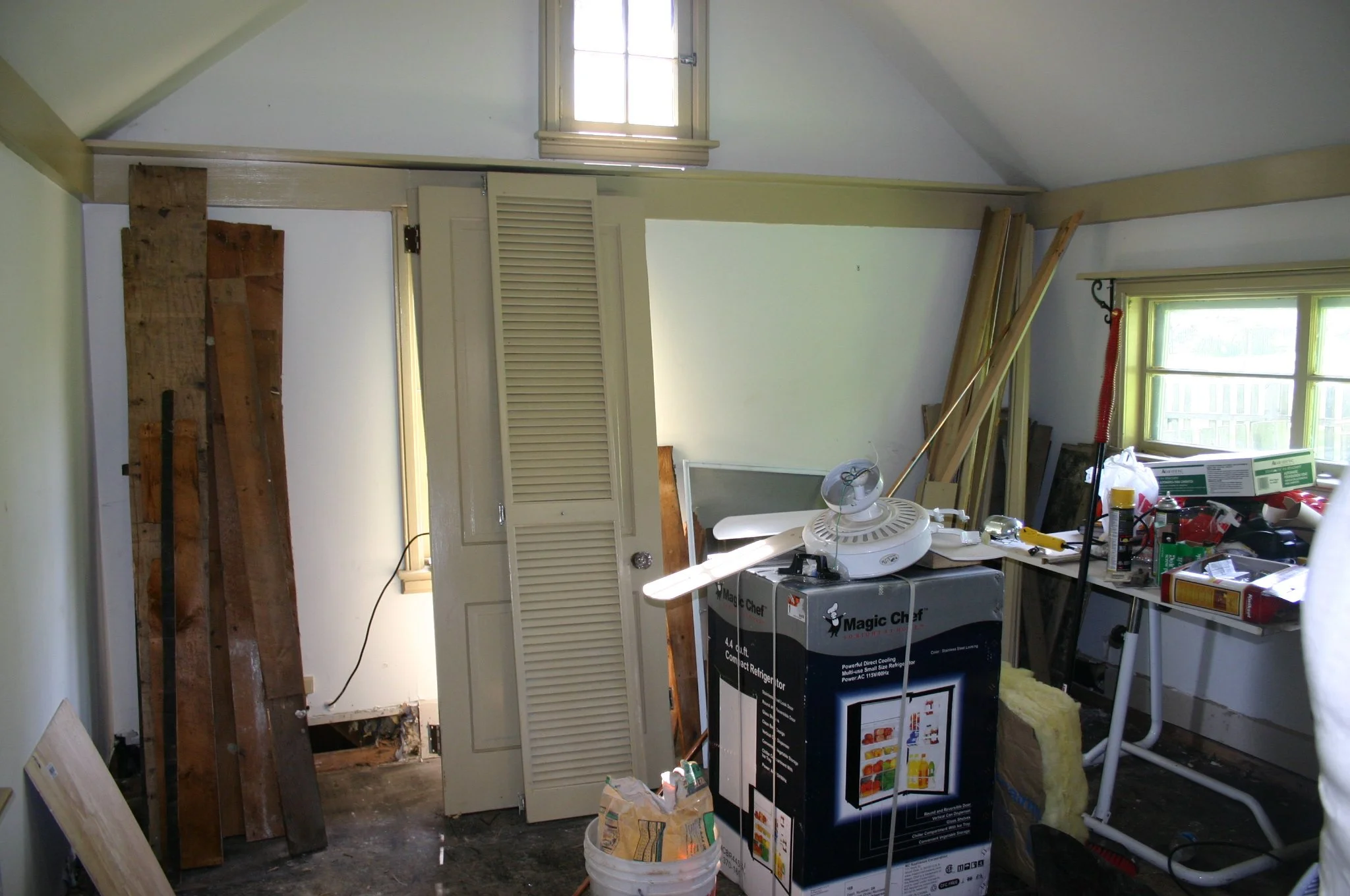
We ripped out a few baseboards to install the electric heat.
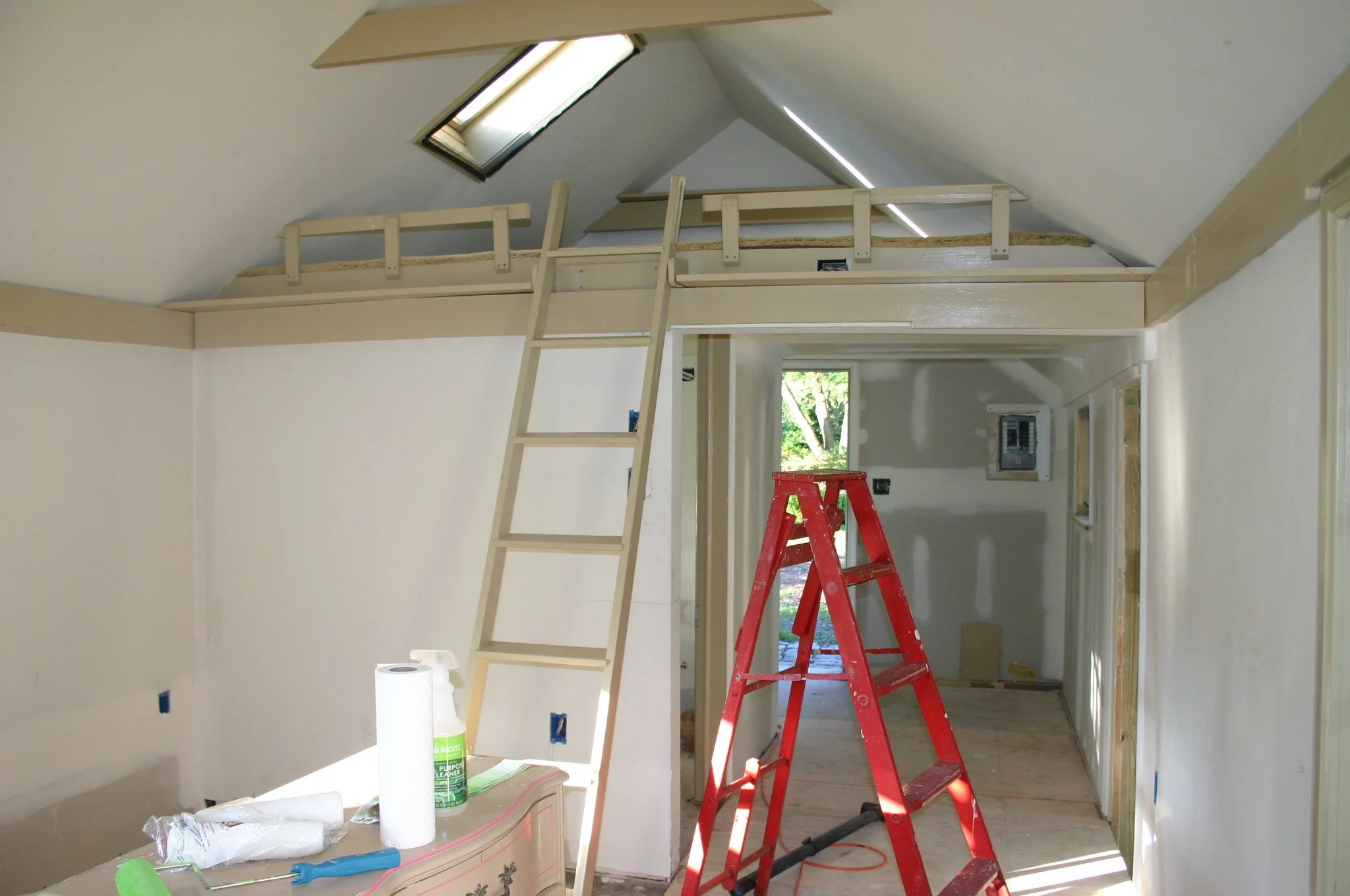
We patched walls and vaulted ceilings with drywall in a few places.

We employed our workforce (I mean our kids) to help with cleaning up.
Cottage Renovations
Originally the exterior was painted a dingy off-white and the cottage always looked dirty, so that was one of the first things we addressed. We power-washed the exterior, brightened it with lime paint, and accented it with an eggplant purple front door! It was eye-catching and perfect for an art studio.
On the inside, We added baseboard electric heat so we could remove the old and ugly oil heater sitting right at the front door. With the help of a friend, we tore out all the carpet, laid a subfloor, and installed hardwood throughout the main rooms and beautiful slate tiles in the bathroom and entry. We patched many walls with fresh drywall, cut a hole for a new door and window, installed some light fixtures, and created a wet bar from an antique dresser. We also had to patch the metal roof because, in addition to a skylight, there was a smoke pipe coming out from the oil furnace. When all the construction was complete we painted all the walls and ceilings with several coats of Benjamin Moore Super White to finish things off. We worked every weekend and I’d say the entire renovation took just over a few months.
Fun Side Note: In the photo below you will see the addition of a side door. We found a cement step in that exact spot, leading us to believe there was once a door there. We kept the step and brought the entry way back to life. I planted walking thyme all around the door when we created our courtyard which you can read about in this blog How To Create A Courtyard. And now the thyme nicely covers the old cement and flowers in the spring.

We removed the oil tank, patched the smoke pipe hole in the roof, and installed electric heat.
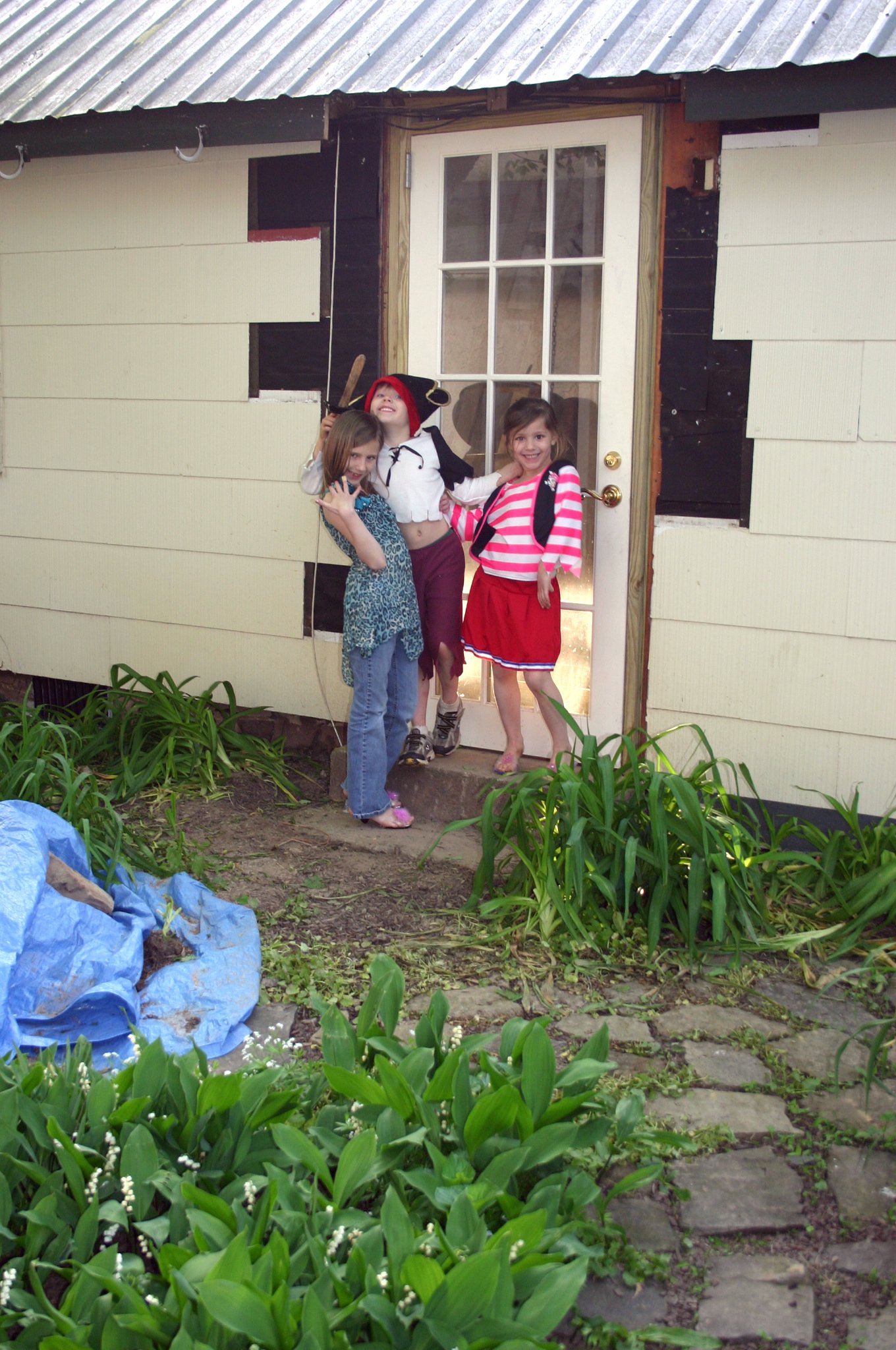
We installed a side door that leads into the courtyard. My 3 kids goofing around in costumes when we had lots of work to do.

Michael and a friend installed the hardwood floors, and I painted the ladder purple. The simple chandelier is from Ballard.

The Artist Cottage at Windy Hill when it was an Artist Studio. We chose bright lime green with an eggplant purple door for the exterior of the Artist Studio. Tile Artist Khara Flint created the “heirloom” tile that hangs above the doorway. I love how the Iceland Poppies decided this was their spot to shine. (they were not planted by me!)
The photos above show how the art studio remained until 2024. We used this space as a haven for Kim Bensing Design and eventually Studio Sprig, my two small business adventures. My kids also used it as a campaway site whenever they had friends over. It was a fun place and still is. It wasn’t until the summer of 2024 that we decided to turn the art studio into a weekend retreat.
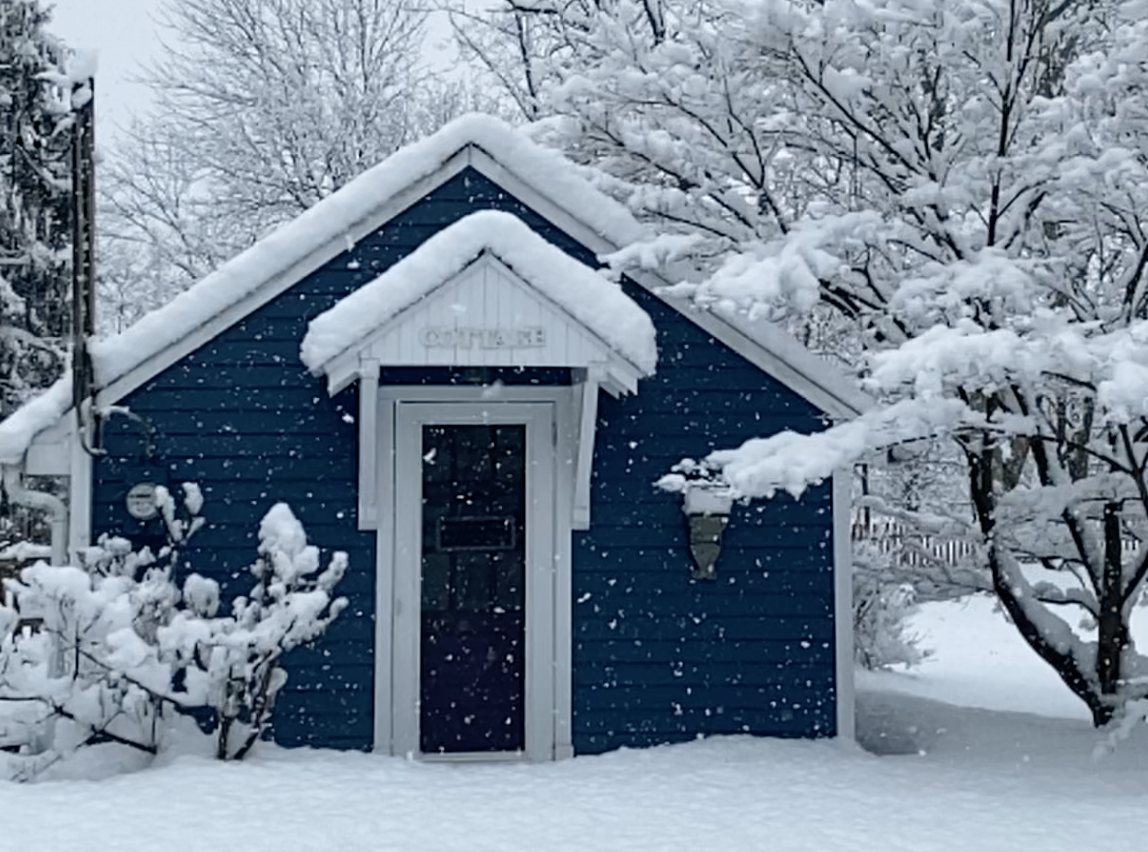
The Artist’s Cottage at Windy Hill today
Creating a Weekend Retreat
The decision to reinvent the space is a direct result of my very 1980s dream of someday owning a bed and breakfast. Fast forward to 2025, and the invention of VRBO.
We knew it would only take a few permits and a couple of updates to turn this Artist’s cottage into a weekend retreat so we came up with a summer plan and ran with it.
Around 2021 two of my Studio Sprig interns and I repainted the cottage exterior with Benjamin Moore’s Van Deusen Blue, so the outside was already freshed up, leaving only the inside to alter.
We started with some interior Super White paint touchups and the we gave the ladder and the front door a new coat of black because they needed to be refreshed as well. We removed the computer desk and replaced it with a comfortable bed and fluffy comforter. We left all the framed news articles about my design business because they add to the appeal. Below them we incorporated a small workstation equipped with a set of watercolor paints, a sketch pad, and drawing pencils. (Guests have been spotted painting in the courtyard and that makes me smile).
So there would be a place to relax, play a game, and eat, we resurrected a small, round yard sale table and paired it with 3 fiberglass spun chairs by mid-century modern artist, Russell Woodward. These were found on Facebook Marketplace. For wall decor, we hung several original paintings, including a watercolor by Bucks County artist, Jane Ramsey, and we also included a few fine art, floral, and photography books from my library, and we displayed them on a recycled children’s wall bookshelf.
In the bath, we refinished the shower with a process called Miracle Method which we learned about on This Old House. This brought it up to date with a beautiful bright white finish. Our electrician installed two new light fixtures, we patched and painted and that was all we needed to do.
The kitchenette is small and not ready to cook full meals, but we added a stainless island with wheels, a retro microwave and toaster by Nostalgia, a coffee maker, and a mini fridge, enough amenities for a weekend retreat.
Thank you for your interest in our labor of love - twice restored. Comment if you have any questions about the renovation, I’d love to hear from you. I’ve included some product links below for your convenience, and f you or someone you know is interested in booking the Artist Cottage at Windy Hill, the next time you visit Bucks County, PA, here is the link.
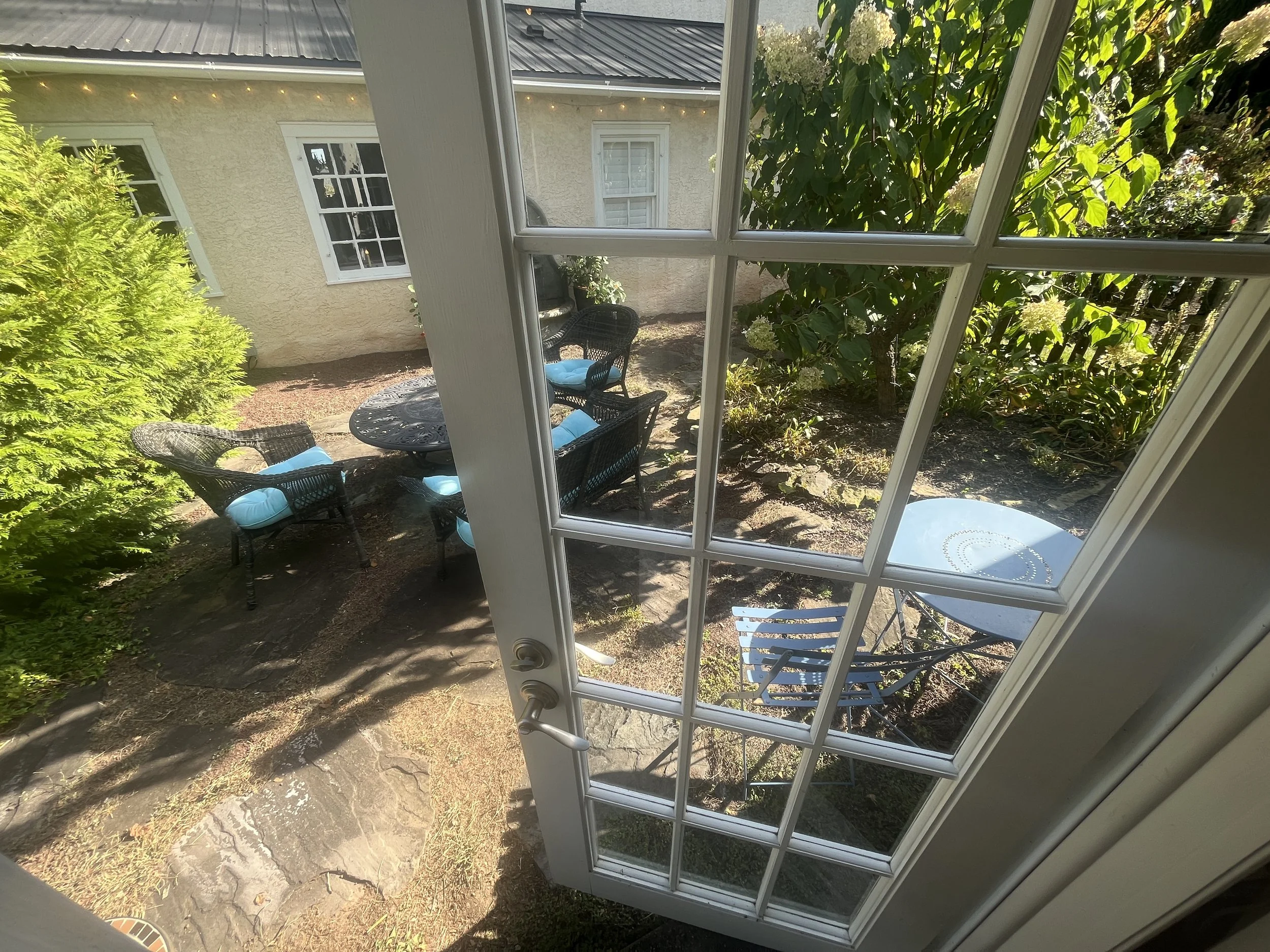
We had this side door installed so there would be access into the courtyard.

The Nostalgia Microwave adds a touch of retro charm.

Fresh white towels in a pretty seagrass basket awaits guests.

Just a simple setup with all the comforts of home.

The pedestal sink was salvaged at an estate sale. The colorful mirror I found at a craft fair. We included a frilly ruffled shower curtain to add texture.

We repainted the loft ladder black and added a round table with chairs for guests.

This rolling, stainless table becomes a nice little countertop.

This is the fountain view into the courtyard.

I supply a set of traveling watercolor paints,professional drawing pencils and a sketch pad for guests to enjoy.

This sink was created from an antique dresser and the Ecosmart tankless hot water heater and all the plumbing hides inside.

Exterior Paint: Benjamin Moore Van Deusen HC-156 / Interior Paint: Benjamin Moore Super White HC-152


I have included a few links to some of the products we used for your convenience. Thank you for reading about this journey. As an Amazon Associate, I earn a small commission from qualifying purchases. The price for you is the same, whether you choose to use the links or not. Thank you.
How to Create a Stunning Centerpiece
How to create a stunning winter centerpiece

Start with a great base
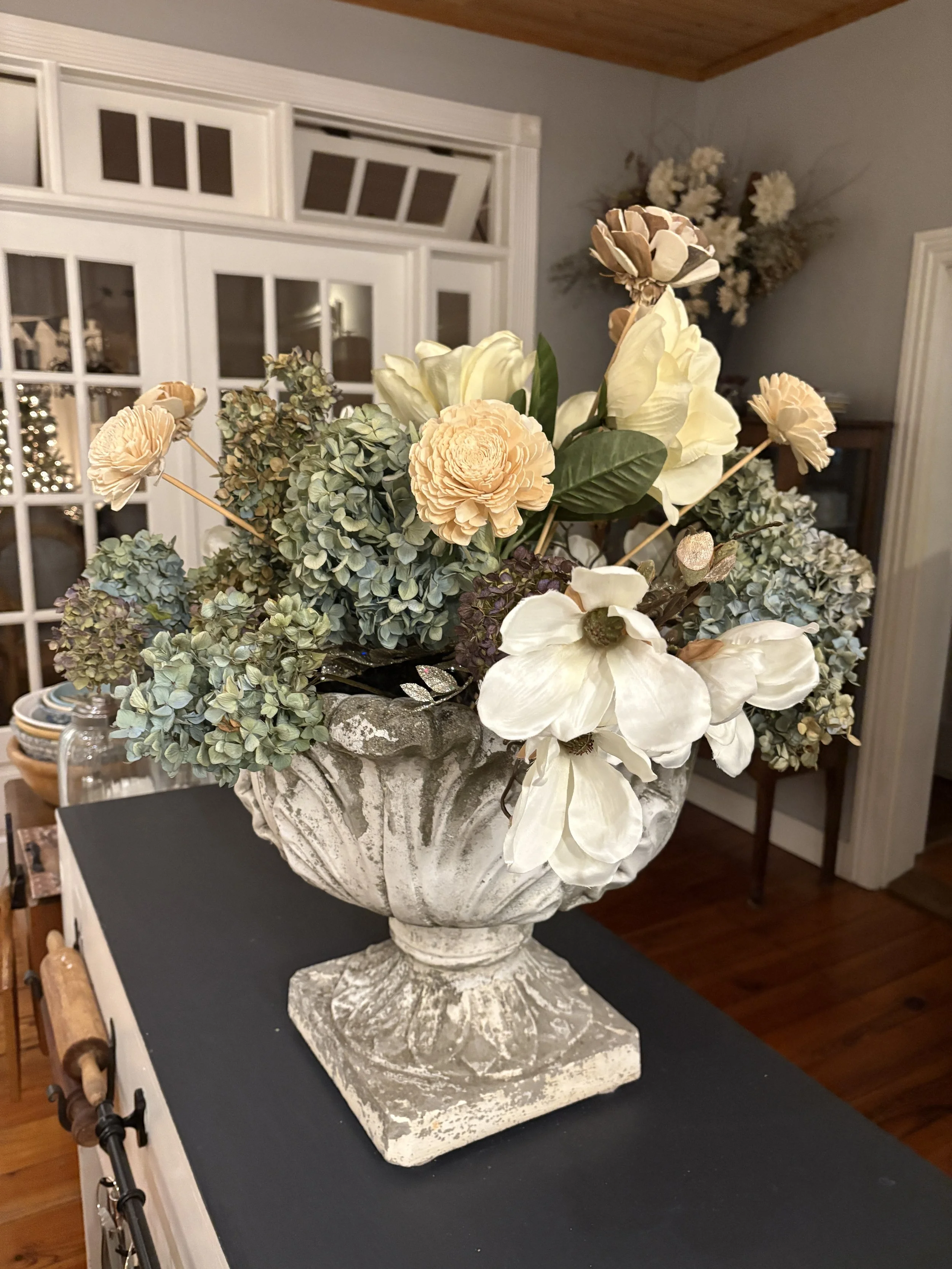
A few months ago I found this fantastic cement pedestal planter on Facebook’s Marketplace. It’s very heavy but I managed to get it into my car with a little help from the seller. I was lucky with this one because the beautiful white paint patina was only flaking off a little bit -just enough to show the age, but not enough to ruin my kitchen, where I decided to showcase this rare beauty. Look around garden centers for one of your own and if you’d like to recreate a smaller version of this, I found this replica.

Find A wreath to cover the top
I found this medium silvery wreath floating around, so I decided it would make a great base for my arrangement. It hides the chicken wire mechanics I placed inside the planter for stem stability and it covers the opening enough without hanging too far over the gorgeous, detailed edges. In hindsight, a looser green wreath would work just as well, and if you only have one that hangs over the edges a bit, that would be okay too because it would look soft and flowing. That being said, I recommend looking around your house for something that fits your decorative base well and if you can’t find something then quickly create a small wreath with wire and fresh greens, branches or even faux foliage. Here is a good starting point if you can’t find or make something. Consider pulling apart an old, worn-out wreath and filling it with something new and fresh, but be sure it will compliment your focal flower color palette nicely.

Focal Flowers
When choosing my palette for this winter arrangement, I went with creamy whites and browns so that my design could last all winter and not need to be changed out soon after the Holidays. I decided to use these faux Magnolia branches and a few off-white wooden stems I had lying around. The Magnolia stems are a mix. I found some at a home decor boutique and I found some at Michaels, The wooden flowers came from Trader Joe’s and I’ve had them for years.

The Execution
To fill in the planter, I began by placing each large Magnolia branch so that it loosely spilled out over the scalloped edges of the planter. I had to bend each long, wired stem so they’d be short enough for the planter. I didn’t want to cut them because I may use them differently next year. Once bent, I liked the way they just randomly popped out here and there on all sides.

Secondary Flowers
Next, I began anchoring the wooden flowers so they’d create height in the center. of the arrangement These stems are held up with the chicken wire inside under the wreath. This is important because, without the inside structure, I would not be able to get this grand height. You could also use floral foam, but I try to stay away from foam whenever possible.

Filler Flowers
Once all the creamy Magnolias and wooden flowers were placed where I wanted them, I grabbed a big bundle of muted dried Hydrangea that I picked from my own gardens, and began filling in the spaces. Dried Hydrangea are a bit messy, but they are so nice and fluffy and they do a great job covering up all the stems and rounding out the arrangement. And I don’t mind mixing faux, silks, and dried, as long as my color palette is pleasing and the overall aesthetic is textural and nice. And if you can’t use dried, here is a link for faux Hydrangea stems.

the End Result
So here is the result. A wintery mix of Magnolia & Hydrangea placed smack dab in the middle of my small, antique, kitchen island. It takes up most of the surface, but I love that. And my favorite part is that I do not have to disassemble after Christmas. This color scheme will take me through the winter very nicely. I hung a few dried oranges from the arrangement on Christmas Eve and I may hang a few small hearts for Valentine’s Day. Please tell me what you think. XO - Kim
Supplies for the Magnolia Cement Planter Design
Replica Pedestal Planter (small)
Wooden Flowers (I found mine at Trader Joes)

Hi, I’m Kim. Welcome to Studio Sprig.
Kim Bensing’s original watercolors and designs are now available on wallpaper and fabric. To order visit Studio Sprig’s design library on Spoonflower. Contact me if you need assistance.
-
EVENTS
22
- Oct 23, 2026 Wrapped in Wonder: The Art of Giving a Gift Oct 23, 2026
- Sep 26, 2026 Homecoming Flowers: A Beautiful Tradition Then and Now Sep 26, 2026
- Sep 23, 2026 Choose Wedding Flowers With Meaning: How to Create a Bouquet That Tells Your Love Story Sep 23, 2026
- Sep 21, 2026 The Pre-Prom Tradition Every Mom Should Try: Host a Backyard Bouquet Party Sep 21, 2026
- Sep 18, 2026 Lambertville’s Halloween Magic: A Funky, Creative Rivertown Comes Alive Sep 18, 2026
- Aug 20, 2026 How to Host a Beautiful Flower Bar: The Ultimate DIY Flower Bar Party Guide Aug 20, 2026
- Aug 19, 2026 How to Decorate Cakes with Fresh Flowers: Floral Wreaths, Crowns & More Aug 19, 2026
- Aug 19, 2026 Decorating Cakes with Fresh Flowers Aug 19, 2026
- May 18, 2025 How to Make DIY Bouquets for Prom May 18, 2025
- May 7, 2025 How to Preserve and Use Your Spring Flowers - All Year Long May 7, 2025
- Feb 27, 2025 Get Excited for The Flower Show Feb 27, 2025
- Feb 14, 2025 Historic Castles. What are they used for? Feb 14, 2025
- Jan 31, 2025 Creative Ideas For Your Valentine Jan 31, 2025
- Jan 28, 2025 How An Invitation Can Tell Your Love Story Jan 28, 2025
- Jan 23, 2025 How to Design a Valentine Tree Jan 23, 2025
- Jan 16, 2025 Host a Fabulous Bouquet Bar for Valentine's Day Jan 16, 2025
- Apr 4, 2023 Why Choose Seasonal Flowers for Your Special Occasion? Apr 4, 2023
- Feb 1, 2023 10 Ideas for an Eco-Friendly Event or Wedding Feb 1, 2023
- Nov 14, 2022 A Family Tree Inspired Wedding Invitation Nov 14, 2022
- Oct 3, 2022 How to choose flowers that have sentimental meaning Oct 3, 2022
- Nov 9, 2020 Simplified Wedding Ceremony during Covid Nov 9, 2020
- Apr 2, 2019 Why You Should Choose Seasonal Prom Flowers Apr 2, 2019
-
HOME
23
- Sep 9, 2026 How to Name a Farm: 10 Meaningful Ideas for Creating a Name With a Story Sep 9, 2026
- Sep 1, 2026 How to Preserve Flowers for Creative Projects Sep 1, 2026
- Jul 2, 2026 How to make your own flower confetti Jul 2, 2026
- Apr 22, 2025 How We Painted our Barn Apr 22, 2025
- Apr 16, 2025 What to Plant for Mesmerizing Spring Blooms Apr 16, 2025
- Apr 8, 2025 Narcissus AKA Daffodil - What's Blooming at Studio Sprig Apr 8, 2025
- Apr 1, 2025 Glory-of-the-Snow - What's Blooming at Studio Sprig Apr 1, 2025
- Mar 19, 2025 How we turned an Artist Studio into a Weekend Retreat Mar 19, 2025
- Mar 12, 2025 The Mighty Crocus - First to Bloom - What's Blooming at Studio Sprig Mar 12, 2025
- Jan 23, 2025 How to Design a Valentine Tree Jan 23, 2025
- Jan 16, 2025 Host a Fabulous Bouquet Bar for Valentine's Day Jan 16, 2025
- Jan 9, 2025 How to Make Your Own Mint Tea Jan 9, 2025
- Jan 7, 2025 How To Create A Courtyard Jan 7, 2025
- Jan 2, 2025 How to Create a Stunning Centerpiece Jan 2, 2025
- Mar 27, 2023 How We Transformed Our Farmhouse Kitchen by Reusing, Updating, and Thrifting: (Coffee Bar) Mar 27, 2023
- Mar 27, 2023 How We Transformed Our Farmhouse Kitchen by Reusing, Updating, and Thrifting Mar 27, 2023
- Mar 1, 2023 How and Why We Love Historic Homes Mar 1, 2023
- Jan 3, 2023 Eliminate Sneaky Sugars Jan 3, 2023
- Dec 14, 2022 How to Create a Pretty Mini Bar with Items You Already Own Dec 14, 2022
- Nov 21, 2022 Friendsgiving At Our Farm Nov 21, 2022
- Nov 9, 2022 Herbs: How to Grow, Harvest and Dry Your Own Nov 9, 2022
- Nov 9, 2022 DIY Herb Drying Rack: Herb Drying at Home Nov 9, 2022
- Oct 12, 2022 Have you ever thought about creating a beautiful water feature? Oct 12, 2022
-
STYLE
27
- Oct 6, 2026 Where Flowers Become Art, Experiences & Memories Oct 6, 2026
- Sep 1, 2026 How to Preserve Flowers for Creative Projects Sep 1, 2026
- Aug 20, 2026 How to Host a Beautiful Flower Bar: The Ultimate DIY Flower Bar Party Guide Aug 20, 2026
- Aug 19, 2026 How to Decorate Cakes with Fresh Flowers: Floral Wreaths, Crowns & More Aug 19, 2026
- Aug 19, 2026 Decorating Cakes with Fresh Flowers Aug 19, 2026
- Jul 2, 2026 How to make your own flower confetti Jul 2, 2026
- Nov 3, 2025 Creating a Pressed Flower Frame Nov 3, 2025
- May 7, 2025 How to Preserve and Use Your Spring Flowers - All Year Long May 7, 2025
- Jan 28, 2025 How An Invitation Can Tell Your Love Story Jan 28, 2025
- Jan 23, 2025 How to Design a Valentine Tree Jan 23, 2025
- Jan 6, 2025 How to Create Oyster Shell Necklaces Jan 6, 2025
- Jan 2, 2025 How to Create a Stunning Centerpiece Jan 2, 2025
- Mar 14, 2023 How to Make Sentimental Easter Eggs Mar 14, 2023
- Mar 6, 2023 How to Enjoy The PHS Philadelphia Flower Show Mar 6, 2023
- Feb 13, 2023 Let's Save The Bees Feb 13, 2023
- Feb 1, 2023 10 Ideas for an Eco-Friendly Event or Wedding Feb 1, 2023
- Jan 12, 2023 A Great Way to Help Kids with Cancer (PENN STATE) Jan 12, 2023
- Dec 14, 2022 How to Create a Pretty Mini Bar with Items You Already Own Dec 14, 2022
- Nov 29, 2022 Lunch and Dinner -Studio Sprig Style Micro Blog Nov 29, 2022
- Nov 14, 2022 A Family Tree Inspired Wedding Invitation Nov 14, 2022
- Nov 9, 2022 DIY Herb Drying Rack: Herb Drying at Home Nov 9, 2022
- Oct 30, 2022 Lambertville, Nj , A Funky, Cool Rivertown You Must Visit on Halloween. Oct 30, 2022
- Oct 19, 2022 How to choose an interesting place to stay when you travel or go on vacation Oct 19, 2022
- Oct 12, 2022 Have you ever thought about creating a beautiful water feature? Oct 12, 2022
- Oct 3, 2022 How to choose flowers that have sentimental meaning Oct 3, 2022
- Feb 1, 2021 How to design marketing materials for your small business Feb 1, 2021
- Oct 29, 2020 Surprise the bride when you can't come to her wedding Oct 29, 2020