

How to Name a Farm: 10 Meaningful Ideas for Creating a Name With a Story
How to Name A Farm -how we named our farm in Bucks County Pennsylvania, Windy Hill Farm after the book The Ghost of Windy Hill.
Choosing a farm name can be one of the most personal parts of making a place your own. The best farm names often come from somewhere real—a family story, the land itself, a favorite memory, an old photograph, or even a beloved book. Here's how I found the perfect name for our historic Pennsylvania farmhouse—and how you can find a meaningful name for yours. A Treasured Storybook
Start With the Story Behind Your Farm
When we decided to name our farm, I didn't want a name that simply sounded pretty. I wanted something that had meaning.
Our farmhouse is located in historic Bucks County, Pennsylvania, surrounded by old farms, stone houses, and beautiful countryside. We moved here in 2007, after our family outgrew our first historic home.
The house we found was a wonderful old clapboard farmhouse with a wrap-around porch, a barn, enormous trees, and plenty of history.
But as much as I loved the property, it didn't have a name.
So, naturally, I decided it needed one.

Front View Windy Hill Farm. Photo courtesy of Kim Bensing Design.
How Do You Choose a Farm Name?
If you're wondering how to name a farm, start by looking around you.
Before making a long list of clever farm names, look for the stories that already exist on your property.
Ask yourself:
What is the history of the land?
Who lived here before you?
Is there an interesting family name connected to the property?
What natural features surround the farm?
Is your farm on a hill, beside a creek, in a valley, or near a particular grove of trees?
Are there old barns, stone walls, gardens or outbuildings?
What animals, flowers or crops are special to the property?
Is there a favorite childhood memory associated with the land?
Are there old photographs, maps, letters or documents that might reveal something?
Is there a book, song or story that has a personal connection to your family?
Sometimes the best farm name ideas aren't invented at all. They're discovered.

Windy Hill’s wrap-around balcony is not original to the farmhouse. We think it was added sometime in the early 1980s. It’s very nice and provides a great place to catch 9 simultaneous fireworks shows on the 4th of July.
Look to the Land for Farm Name Ideas
The landscape itself can be a wonderful source of inspiration.
Think about words that describe your property:
Hill • Hollow • Meadow • Grove • Creek • Brook • Orchard • Field • Valley • Ridge • Woods • Garden • Acres • Farm
You can combine these with something personal.
For example:
Willow Hill Farm
Fox Hollow Farm
Meadow Grove
Old Oak Farm
Windy Hill Farm
Rose Hill
Bluebird Farm
Orchard House
A good farm name doesn't necessarily need to explain everything about the property. Sometimes one evocative word is enough to create a feeling.

Snow covered little Cottage at Windy Hill Farm. Photo courtesy of Kim Bensing Design.
Look Into Your Farm's History
If you own an older property, spend some time investigating its past before choosing a name.
Old deeds, maps, photographs, newspapers and family records can reveal fascinating clues.
And don't overlook your neighbors.
Someone who has lived in the area for decades may know something about your property that you could never find online.
That's exactly what happened to us.

Walpole Lamppost and sign created by McElHaney Signs here in town.
The Story Behind Windy Hill Farm
For years, I had owned a little vintage children's storybook called The Ghost of Windy Hill.
It was one of my favorite weekly readers as a child, and somehow that little book stayed on my bookshelf throughout my entire life.
The book was written in 1966—the same year I was born—and the story takes place in 1851, around the same era our farmhouse was built.
I had never imagined that the book would eventually inspire the name of our home.
But then we discovered something about the property.
Our farmhouse sits at the top of a ridge, surrounded by enormous old trees. The wind moves through the property constantly, whistling through the original windows and across the hill.
When it gets windy here, it gets really windy.
Suddenly, the name seemed obvious.

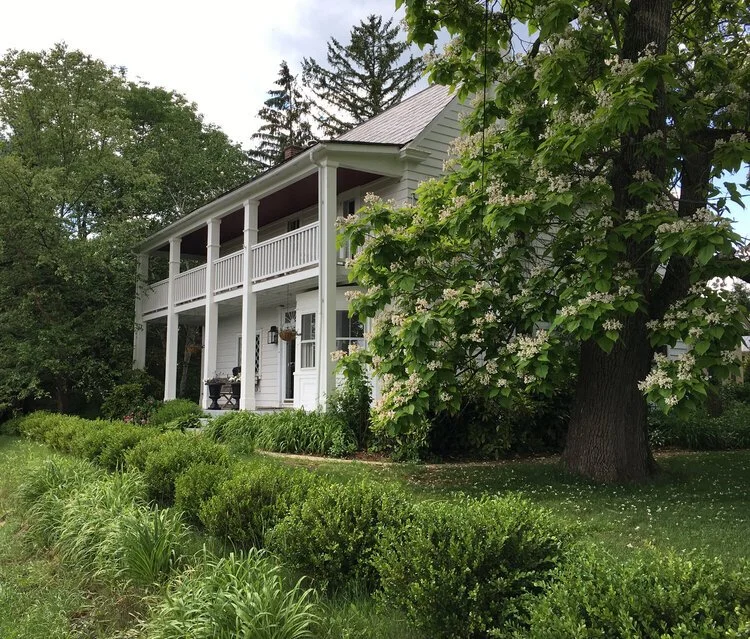
Windy Hill’s side view with a big old tree. Photo courtesy of Kim Bensing Design
Windy Hill.
The old storybook gave the name a personal history, while the land itself gave it meaning.
And just like that, our farm had a name.

View of Windy Hill’s Barn behind a lilac. Photo courtesy of John Arehart Photography.
Sometimes the History Finds You
After we named the property Windy Hill, something unexpected began happening.
People started stopping by.
Over the years, approximately twenty people have told us that they had once lived in the house, visited the property or spent time in the old barn.
Then one summer day, an older woman named Dee and her daughter stopped by.
Dee told us that she and her cousin had spent summers here during the 1930s. The farm had belonged to their aunt and uncle, and the property held some of her favorite childhood memories.
A week later, Dee returned with her cousin.
They brought old photographs.
They showed us pictures of the property from decades earlier and even brought a hand-drawn floor plan of the house.
As we walked through the rooms together, they remembered where old doorways had been and explained why certain parts of the house seemed unusual.
Then Dee's cousin stopped before what is now our dining room.
He said there had once been a large hole in the floor for the heat.
We had always known there was something unusual about the floorboards, but we had never understood why.
Sure enough, there was a covered opening exactly where he remembered it.
It was one of those moments when a house stops being simply a house.
It becomes a story.

Dee, her daughter, her cousin, Kim & Mike Bensing.
Meaningful Farm Names Often Come From the Past
That experience changed the way I think about naming a property.
A farm name doesn't have to be clever.
It doesn't have to follow a trend.
And it doesn't have to be something you come up with in one afternoon.
The most memorable farm names with meaning often connect the present to the past.
Your perfect name might be hiding in:
An old family photograph
A childhood book
The name of a former owner
A nearby landmark
A favorite tree
A creek or hill
An old field name
A family tradition
A local legend
The history of the property
A meaningful event that happened there

How to Choose the Right Farm Name
Once you've gathered your ideas, make a short list.
Then say each name out loud.
Does it feel natural?
Is it easy to remember?
Can people spell it?
Will it still make sense if your farm changes or grows?
And most importantly:
Does the name mean something to you?
A good farm name should feel like it belongs to the land.
You don't necessarily need the most unique name. You need the name that feels right.

Dining Room Floorboards at Windy Hill Farm.
Give Your Farm a Name That Can Become Part of Its History
After choosing Windy Hill, we installed a beautiful lamppost and sign at the entrance to the property.
That little sign became more than decoration.
It gave our home an identity.
Over the years, it has become part of the story of this place—and now, whenever someone asks where we live, I can simply say:
Windy Hill.
And somehow, that says so much more than an address ever could.
If you're trying to name your own farm, farmhouse, homestead or historic property, look for the story before you look for the name.
You may discover that the perfect name has been there all along.

Historic Images of Windy Hill Farm circa 1930s.
More Studio Sprig Inspiration
If you love historic homes, gardens, flowers and the stories behind beautiful places, explore more of Studio Sprig's floral art, surface patterns and inspiration from Windy Hill Farm.
And if your property has a story of its own, I'd love to hear it.
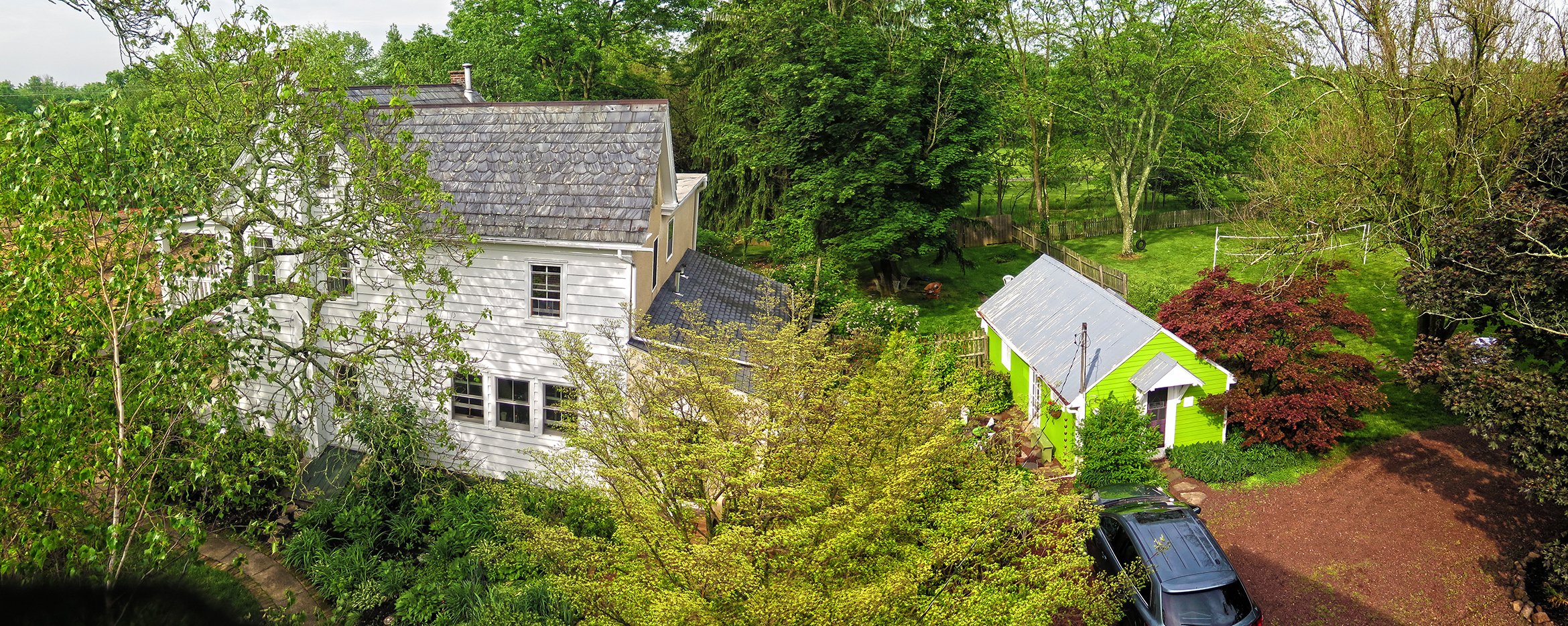
View of Property from the Barn. Photo courtesy of John Arehart Photography.

How to Make Sentimental Easter Eggs
HOW TO MAKE SENTIMENTAL EASTER EGGS

Easter is just around the corner, and it’s time to start thinking about easy-to-do spring decor ideas. Sentimental eggs that tell a story are a great way to add interest to the season. Creating a decoration that you can display every year is a meaningful way to enjoy a happy memory, and reusing something worn and weathered is a great way to honor the environment too.
Why maKE sentimental eggs?
Last year I created these pretty floral eggs with a vintage pillowcase that has a story. This particular pillowcase was part of a set of vintage sheets my mother chose for me when I was a child. When my children were small I hired a seamstress to design clothing using some of my hand-me-down vintage sheet sets (don't worry, I will blog about that soon because they were awesome!). But this time I made eggs instead.

This particular pink and green pillowcase above was an outlier that I was mixing in here and there with my other linens. I used it for many years and always took great care of its delicate nature, however, as expected over time it wore very thin. One day, my washing machine completely shredded it and I was sad because it reminded me of my mother. So instead of throwing it in the garbage, I wondered what I could do to preserve it. I decided since Easter was my favorite holiday, that I'd try to create a few decorative eggs so that I could enjoy this childhood memory every year going forward. The samples I created tell a story, so they are now the first set of what I am calling my Story Eggs.

the BEST FABRIC FOR MAKING story eggs
I used floral, vintage sheets from my childhood, but you can also use any scrap of sentimental fabric you can find. Maybe it is a small clipping from your grandmother’s wedding dress or a cutting from your child’s favorite cotton onesie. I would recommend hunting for thin cotton as it's much easier to work with. For reference, thin, vintage pillowcases are the perfect texture and work very well.
Estate sales and thrift shops are great places to hunt for fun and fabulous vintage cloth. You don't need much fabric for this project so if you go to a fabric shop ask if they have quilting squares, as that's another great source that won’t cost a lot. If you’ve never heard of Spoonflower, they also have the option to order an 8”x8” square swatch for just $5 with any pattern you choose, and better yet you can even upload your own pattern designs and create your own custom fabrics. Imagine uploading your child’s artwork, creating a pattern, and having spoonflower print it on fabric. I’ll put a link at the bottom for you to see what I am talking about. I have also included more links for pillowcases and trims at the bottom of this post. Use your imagination and gather what works best for you to create your own memorable Story Eggs.

WHAT TYPE OF EGGs SHOULD I USE?
I don't like to use real eggs because they are hard to work with and they can crack and spoil over time. I also don't recommend plastic eggs because they aren’t substantial enough. Instead, I recommend using an assortment of really nice wooden eggs.
Here I used very inexpensive white wooden eggs, but you can also order brown wooden eggs. And I also found a collection of white, brown, and pale green wooden eggs which closely resemble the chicken eggs I buy from my neighbor.
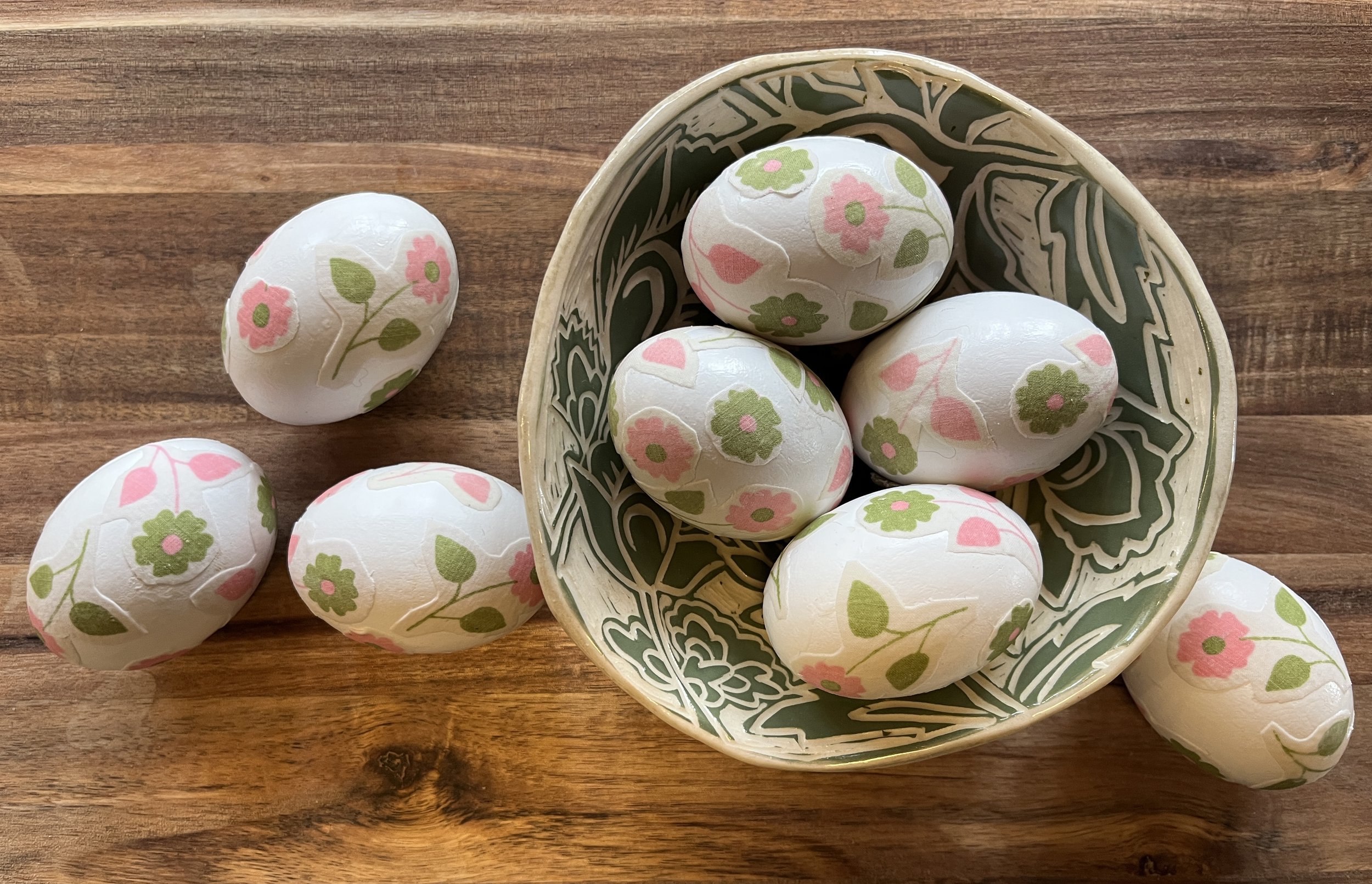
Creating a Story Egg with your own sentimental vintage fabric is an easy and fun DIY project that is sure to reignite happy memories. Even children can create these eggs using the simple directions below. With just a few supplies and your creativity, you can make beautiful eggs that will make your Easter and Spring celebrations even more special. When finished, pop them into a child’s easter basket, or present them as a housewarming gift in a simple pottery bowl as I did. They can just be little decorations complimenting your larger Easter Table Ensemble or let the creation of your Story Eggs be an “egg painting alternative” for a family gathering. Either way, I hope these eggs spark many sentimental conversations. Whether your creations are used to decorate for the holiday, become a new family craft, or are given as gifts, try to come up with a new Story Egg idea each year so that this can become a cherished part of your traditions.
To create a story egg you will need:
SUPPLIES:
Fabric Scissor
Small Paint Brushes
White wooden eggs
Mod Podge (Matte Finish)
Fabric
OPTIONAL SUPPLIES:
Brown wooden eggs
White, brown, and pale green wooden eggs
Mod Podge (Gloss Finish)
Pink Vintage Inspired Pillowcases
Blue and Green Vintage Inspired Pillowcases
Purple Floral Inspired Pillowcases
Rick Rack Trim various colors
Egg Cups for drying
Translucent Bags
CREATE YOUR OWN FABRIC WITH SPOONFLOWER:
Spoonflower Custom Fabric Squares

FOLLOW THESE STEPS:
Step 1: Prep wooden eggs
With a slightly damp cloth, clean your wooden eggs to make sure they are free of any dust and debris.
Step 2: Cut fabric designs and patterns into small pieces
Use a fabric scissor to cut around your designs and patterns, breaking them into small portions. Smaller sections, not larger than 2” work best. I simply cut around each flower and stem.
Step 3: Decoupage your eggs
Break out a roll of paper towels to cover your work surface, then use a small paint brush and a small amount of decoupage glue (I use Mod Podge) on the egg (only in the area you'll be adhering your first piece). Then place the piece on that glue. Let dry.
Once you've gone around the entire egg and placed all of your pieces, you are ready to paint Mod Podge over all the fabric pieces and all bare egg surfaces as well. If you choose a matte finish they will dry like mine. A gloss finish is another option. All links are below.
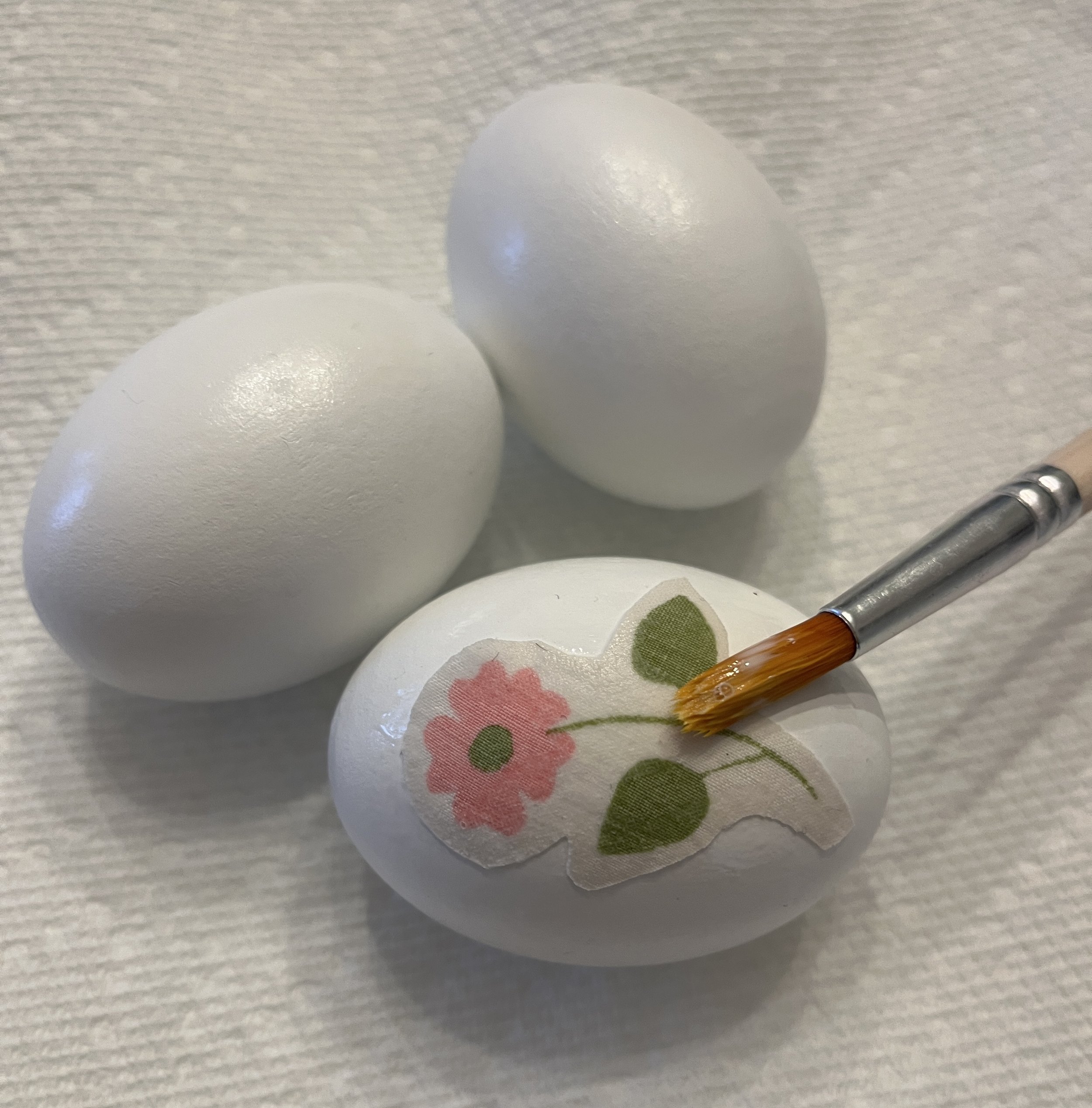
Step 4: Dry your Eggs
This is a great time to pull out your mini egg cups or deviled egg dishes if you have some. The eggs need a place to dry so they do not roll around. You can also use the underside of an egg carton.
Step 5: Display or Package Your Story Eggs
Once your eggs are completely dry, find a pretty bowl or basket for display. If your eggs are created from a sentimental fabric you may want to place each one into a special little translucent bag as I did below and give them to members of your family. You may also choose to add painted polka dots, stripes, or a wedding date or name to complete the memory. This is completely optional.

I’d love to see your Story Eggs or hear about other ways you’ve made sentimental eggs from things you love. If you are enjoying my blog, please share it with friends and subscribe here so you can read the next one.

If you’re a blogger, what’s your favorite SEO Tool? I’ve had keyword success with RankIQ. Learn more here. If you enjoyed this Creative Inspiration you may also like this: DIY HERB DRYING RACK: HERB DRYING AT HOME
How and Why We Love Historic Homes
The first home we bought when we moved to this area was this 18th-century Stone Colonial. It was so unique, very well maintained, and quintessentially Early American.

A Little History
One of the things we love about this area of the country, Bucks County, Pennsylvania, is the availability of historic homes and properties. Bucks County boasts 12 original covered bridges and there are gorgeous barns and farms all over the place.
The first home we bought when we moved to this area was this 18th-century Stone Colonial. It was so unique, very well maintained, and quintessentially Early American. It had very uneven measurements, only 2 full bedrooms, and a little walk-through space off the master (which we quickly crafted into a nursery), a woodburning stove, a classic pie staircase, beautiful deep windowsills, a nice brick courtyard with a farm bell and climbing roses, a garden-filled yard, and a sweet little cottage (which became my studio).

Side view of stone colonial home.
Why our homes are sentimental
We lived in this home from 1998-2007 and it was our first so of course, it’s sentimental. Our young family loved and used every square inch of it because it was not very big. It was built from beautiful fieldstone and because it was well taken care of previously it did not require a lot of work or renovation which was perfect for that time of our lives. The only problem was that the home became a little too small for our growing family over time and it also sat on a busy road. This position near the road made sense when it was built in 1780 because it was built on a main road leading straight to Philadelphia, but in 2007 it was no longer a workable feature with our three young children, so we decided we needed to find something a little different. Not an easy decision as we had grown to love this little beauty.

Farm bell with climbing roses and two dancing queens.

Our family portrait in front of the Stone Colonial Home. Photo Courtesy: Catherine Byvelds
A Victorian Farmhouse up the hill
We searched for a new home for quite a while, always looking for another historic gem that we could easily call home. Eventually, we actually found a white Victorian Clapboard Farmhouse with 3 outbuildings that were literally up the hill (foreshadowing Windy Hill) from our original Stone Colonial. This worked out well because purchasing this Victorian would mean we wouldn't have to pull our children out of the primary school they were attending and could essentially stay connected to our neighborhood friends. It also had 4 massive bedrooms and a cottage apartment on the property so to us it seemed just like the Taj Mahal!!!

Windy Hill Farm in spring.
Learning about our home
Once we were certain this place was for us - but before the purchase, I made it my personal mission to befriend the current owner so that I could really get to know her, the house, and its history because I knew she had loved it for a very long time and that she felt the same way about historic properties. She told me she was searching for the perfect family to love her home. If you haven’t picked this up already, what you must know about owners of historic properties is that they are obsessed. They may be obsessed with history, architecture, farming, antiques, or ghosts, but trust me, they are in love with something like that and that is why they are drawn to care for a piece of history in the first place.

Windy Hill Farm in winter.
research with tea
So, because I am one of the obsessive types, I set up “tea dates” with the lovely woman who had owned this home for over 30 years so we could discuss all the little nuances that are so important to understand when buying an older home. She graciously filled me in on details about the gardens and the herds of yard deer (yes, that’s a thing), the neighbors, the well and water pipes, the paint colors she used and why she used them, the utility schedules, the septic system, and important details about the rental income the farm provided and how and why it would be in our best interest to keep that going.

Kids greet from the balcony.
how Rental Income sealed the deal
When purchasing a historic farm, don't underestimate the power of passive rental income. One of the reasons we chose this farm was because it came with established rental income derived from an outbuilding at the back of the property. The large outbuilding had been previously renovated and divided into 4 distinct storage-only garages: one to be used by the owner as a garage for the lawn mower, bikes, tools, and such, and the other 3 to be used for a home business or rented out if desired. There is a private driveway to this building and all access is in the back, so tenants never have to disturb the family in the main house.

Out building provides rental income.
Plant, don’t demolish
Full disclosure, at first I just wanted to demolish the building completely (I was strongly “persuaded” to plant pine trees instead) but today I’m glad we didn't demolish after all because, over the last 16 years, the building has provided a very nice passive income which took care of half of our monthly mortgage, and it has allowed us to do the many renovations and updates we've wanted to do on the original farmhouse and cottage. It also paid for exciting family vacations, and currently, it's helping to pay 3 simultaneous college tuitions. I now have more of an open mind and if you are searching for a historic property, I recommend finding a way to generate some passive income.

Kids planting first pines which will help to pay for their college!
Creative home inspirations
When we moved into the Victorian Farmhouse in the summer of 2007 we were very content with the state of the home. It had great bones, lovely updates, and many classic features. There is a main farmhouse, a big, green 4-story bank barn, a little studio cottage (perfect for my designing), and that long outbuilding above that we soon rented out. Bonus! Sure, this home would eventually need some updates, but we had three kids to raise, a lot of time, and much more energy then, so we were not in a hurry. Nevertheless, creative renovations did eventually happen everywhere (and sometimes twice) so sign up to receive alerts about the entire project and the way we did "creative home inspirations" here at Windy Hill. Below is a sampling of what is to come. If you enjoy this blog please comment below and share it with your friends. And you can subscribe here. Thank you, Kim

Side view of Windy Hill Farm.
Creative Home Inspirations….Sign up so you don’t miss them!
A Cute Courtyard & A Scary Tree
Weedy, Old Heirloom Gardens
The Cottage Becomes a Studio
A Yard Sale-Inspired Kitchen
A Wisteria-Covered Outdoor Entertainment Space
Our Peek-a-Boo Pantry
A Floral Workshop
An inviting Mudroom
The Under-the-Stair Secret Hideaway
A Lite & Bright Family Room
An Arhaus-Inspired Dining Room
A Fun & Foral Laundry Room
Our Simple and Fresh Bathrooms
The Transformable Bedrooms (Kid-to-Teen)
A Classic Living Room, Game Room & Home Office
The Marriage Marked Bank Barn
Shop the look at Windy Hill Farm! If you’re a blogger, what’s your favorite SEO Tool? I’ve had much keyword success with RankIQ. Learn more here.
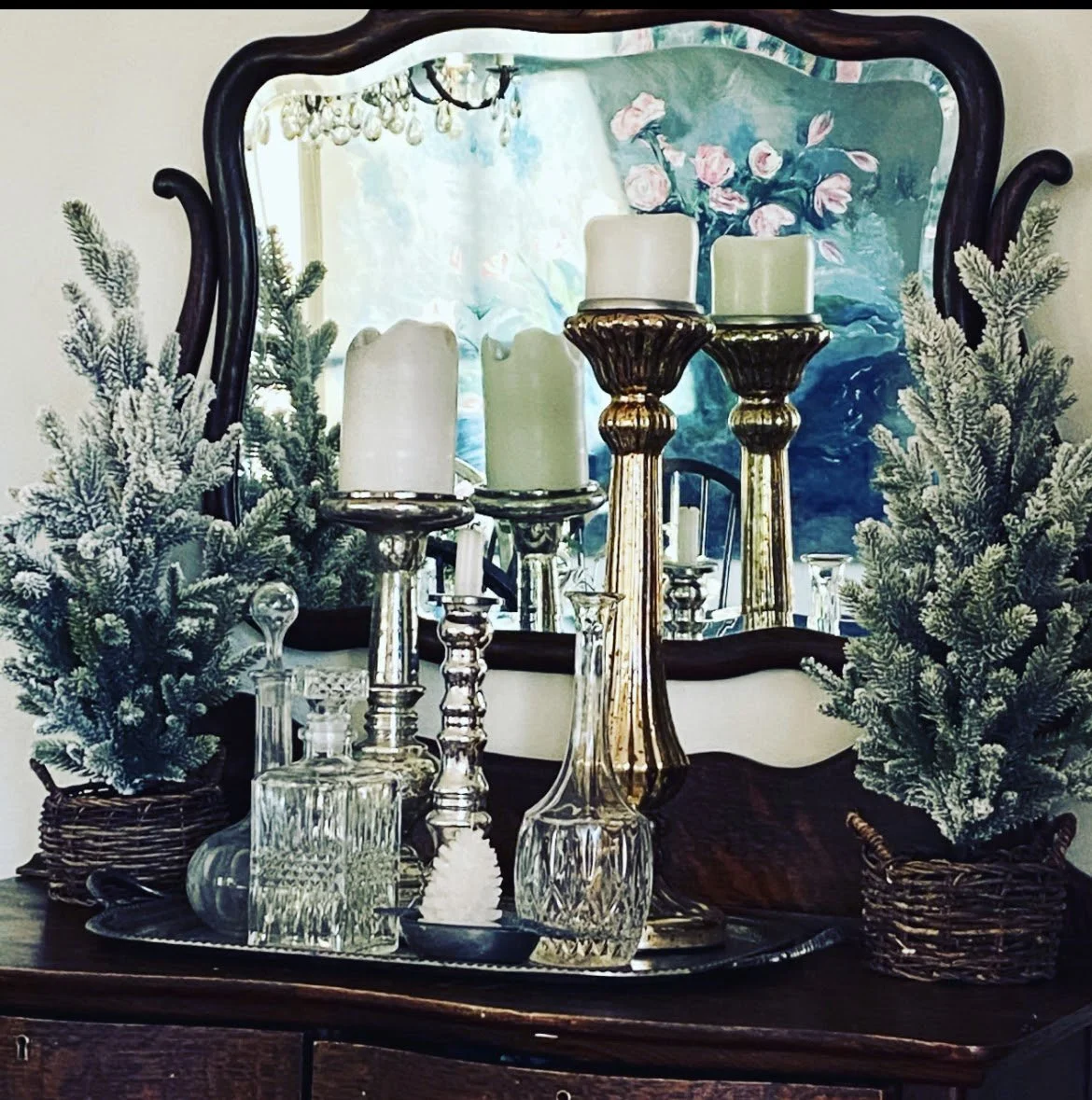
How to Create a Pretty Mini Bar with Items You Already Own
Creating a pretty mini bar with items you already own.

Do you find it difficult to turn away pretty decanters, cast-off crystal, or pewter candlesticks? Whether you relish rummaging thrift shops every once in a while, or you inherited your grandmother’s formal dining room and you don’t have the heart to give it all away, rest assured, you can create something fashionable and functional that will be a big hit the next time you entertain.
A few years back I hosted Christmas Eve for my extended family which, at the time, consisted of 9 very light drinkers and 10 teens and pre-teens. I needed to create a semi-dry mini bar but I wanted it to be spectacular and not just a kitchen counter filled with soda, iced tea, and fruit-infused sparkling water.
First, find a Bar
Everyone today seems to be buying stylish, rolling mini-bars. While I like the look of them, I could never seem to find space to store one in our farmhouse. And their mid-century modern style never really fit with my antiques anyway. That being said, I don’t own one, nor do I have a traditional, custom bar anywhere in this home, so when I wanted to create a holiday mini-bar, I needed to find my own way.

Tucked in a corner of my dining room is this antique dresser or bureau that I acquired from my paternal grandmother’s home. For many years I used it in an obvious space, a bedroom, but eventually, I grew tired of using it in a traditional way. So I had my son and husband move it down to the dining room where it happily lives today. I actually really like it here because its many drawers are very useful. I now have a practical space to store my vintage tablecloth collection and the many cloth napkins I keep pressed and ready for pop-up entertaining. I decided to use this as my bar. But you can virtually use anything, an existing sideboard, a built-in bookshelf (which I’ve also used), anything. I even converted an outdated corner TV hutch into a mini-bar after I saw the same thing in Pottery Barn for over 3K- but that is in another room so I’ll save that for another blog.
Look around and use your imagination instead of your wallet. You’ll find something cool at home and when you do be sure to photograph it and post it in the comment section for our idea bank.

The Embellishments
Next, I’d like to encourage you to always use what you already have around your home to create this very pretty mini bar worthy of conversation. There is no need to buy anything except maybe an inexpensive knock-out crystal piece - but if you do, be sure to get that from a thrift shop. Upcycling is better for the environment and giving a piece a “second chance” just makes the heart warmer.
So take a walk around your home. Go to your attic, basement, or anywhere you stashed all the items from your long-lost relatives that you didn’t quite know what to do with, and just couldn’t throw away. Open every hutch and sideboard, every cupboard and buffet, and see what pieces you’ve forgotten about. A few glass or pewter candlesticks? Grab them. Some mismatched crystal wine glasses? Snag them. In fact the more eclectic the pieces, the better. There is no need for a full set of anything here. You are creating the bar of misfit toys.

Fancy Decanters
If you haven’t already inherited a few of these little gems, then I suggest taking a trip to your local thrift/consignment shop. There you will find a treasure trove. Visit their glass or china section and basque in the glow of unwanted decanters.
Decanters were very popular mid-century but aren’t used very much these days. Unless you come to my home on Christmas Eve. I think it’s a shame because they are elegant and in my opinion, they display liquid beverages best.
Far back in antiquity, decanters were used to transport beverages like wine and spirits that could have lingering sediments. Decanting liquids gives the liquids room to breathe which enhances aroma and flavor. Wine and some spirits continue to be decanted to this day.
Remember, when you find your perfect-for-you decanters, be sure to give them a good cleaning. Here is a great resource for that. The decanters I am sharing are just a few that I inherited. I have some that came to me without stoppers, and I don’t let that stop me from using them. I love them just the same. But I do really embrace the ones with fancy stops.

pretty Pitchers
And as you’re probably suspecting, I also have a small collection of vintage glass pitchers. I think I only purchased one on the Facebook marketplace. All the others were entrusted to me by relatives who knew I would actually use them.
It’s true, I use them all the time because I just think they are so beautiful. For me, the glass works well because as you’ll see later I embellish my mini-bar with loads of candles, and I love the reflections in the mirror, but for you maybe pottery pitchers are more your style. That’s great. Use whatever you have that speaks to you.


Is it an Ice Bucket?
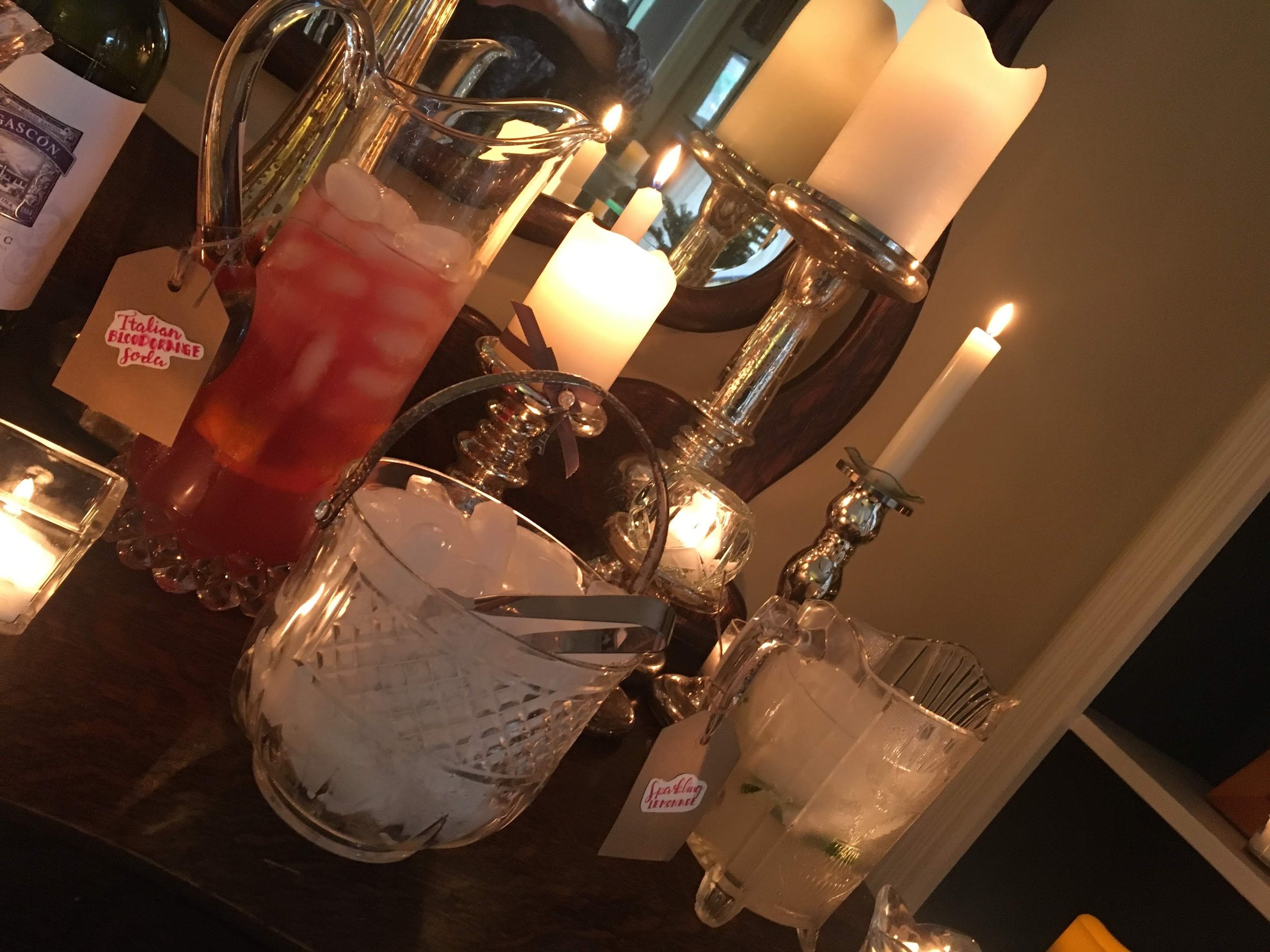
Who knows. I inherited this glass bucket from my parents who probably used it for their Swanky Sixties Soirees. I’m not sure it was an ice bucket, but I love it and use it as such. I can easily see when the ice melts and it has a handy silver handle for quick refills. Everyone has something like this around their kitchen. Any pretty glass bowl will do. And DO NOT BE AFRAID to pull out your vintage punch bowl either. I use mine all the time to actually serve punch. It’s only outdated if you care that it is. It happens to be a very pretty and effective way to serve teenagers something fancy.
toggling Tags
It’s important your guests know what they are drinking so I like to use labels.
For this occasion, I served two fancy lemonade pitchers whose content originally came in bottles from Trader Joe’s. Nothing too complicated here. I just added a little ice, a lime, and then poured in the bottles. Voila…pretty pitchers full of cheer for the kids to enjoy.
To label the pitchers and decanters, I like to sometimes make interesting theme-appropriate tags to match the occasion or you can also just keep all-occasion brown kraft tags and twine in your mini-bar drawer, as I do, so they're ready to swing whenever you are.

Add some sparkle
And to top it all off I try to keep tall and short mercury, pewter & glass candle holders around so that I can just bling up the mini-bar on demand. You can find silver or gold or even pink mercury votives here. I think having a few of each allows you to easily change your mini-bar for interest if entertaining the same friends over and over. I always have a stash of votive candles and dripless tapers in one of these drawers and I hunt for sales on pillar candles wherever I go. But the cool thing about making your own mini-bar is that you can change it up with every whim, season, or holiday. For instance, you can use black votive candles at Halloween to accent your ghoulish punch bowl or red candles on the fourth of July next to small galvanized buckets full of blue jello shots.

Thank you for reading this blog. I hope it inspired you to carve out a little unsuspecting portion of your home to create a festive corner for refreshment. I’d love to hear your ideas below.
Learn: Why do they call it mercury glass? The reason it is sometimes called Mercury Glass is that in the early days the internal coating was sometimes mercury or a mercury product. However, mercury proved unsuitable and dangerous, and today silver nitrate is used instead.
Create: Here is a lovely Virgin Blueberry Lime Cocktail recipe created by my friend Rose. Please let both of us know what you think.
Inspire: The holidays are right around the corner. While visiting family or friends, show up with a vintage decanter or fancy glass pitcher Be sure to attach a little tag and “gift them” your beverage of choice. Cheers!
I’m always here to help you with your creative journey. Please sign up to receive blog post notifications and follow Studio Sprig on Instagram, Facebook, and Pinterest. I look forward to connecting. If you’re a blogger, what’s your favorite SEO Tool? I’ve had much keyword success with RankIQ. Learn more here.

Virgin Blueberry Lime Cocktail
Hi, I’m Kim. Welcome to Studio Sprig.
Kim Bensing’s original watercolors and designs are now available on wallpaper and fabric. To order visit Studio Sprig’s design library on Spoonflower. Contact me if you need assistance.
-
EVENTS
22
- Oct 23, 2026 Wrapped in Wonder: The Art of Giving a Gift Oct 23, 2026
- Sep 26, 2026 Homecoming Flowers: A Beautiful Tradition Then and Now Sep 26, 2026
- Sep 23, 2026 Choose Wedding Flowers With Meaning: How to Create a Bouquet That Tells Your Love Story Sep 23, 2026
- Sep 21, 2026 The Pre-Prom Tradition Every Mom Should Try: Host a Backyard Bouquet Party Sep 21, 2026
- Sep 18, 2026 Lambertville’s Halloween Magic: A Funky, Creative Rivertown Comes Alive Sep 18, 2026
- Aug 20, 2026 How to Host a Beautiful Flower Bar: The Ultimate DIY Flower Bar Party Guide Aug 20, 2026
- Aug 19, 2026 How to Decorate Cakes with Fresh Flowers: Floral Wreaths, Crowns & More Aug 19, 2026
- Aug 19, 2026 Decorating Cakes with Fresh Flowers Aug 19, 2026
- May 18, 2025 How to Make DIY Bouquets for Prom May 18, 2025
- May 7, 2025 How to Preserve and Use Your Spring Flowers - All Year Long May 7, 2025
- Feb 27, 2025 Get Excited for The Flower Show Feb 27, 2025
- Feb 14, 2025 Historic Castles. What are they used for? Feb 14, 2025
- Jan 31, 2025 Creative Ideas For Your Valentine Jan 31, 2025
- Jan 28, 2025 How An Invitation Can Tell Your Love Story Jan 28, 2025
- Jan 23, 2025 How to Design a Valentine Tree Jan 23, 2025
- Jan 16, 2025 Host a Fabulous Bouquet Bar for Valentine's Day Jan 16, 2025
- Apr 4, 2023 Why Choose Seasonal Flowers for Your Special Occasion? Apr 4, 2023
- Feb 1, 2023 10 Ideas for an Eco-Friendly Event or Wedding Feb 1, 2023
- Nov 14, 2022 A Family Tree Inspired Wedding Invitation Nov 14, 2022
- Oct 3, 2022 How to choose flowers that have sentimental meaning Oct 3, 2022
- Nov 9, 2020 Simplified Wedding Ceremony during Covid Nov 9, 2020
- Apr 2, 2019 Why You Should Choose Seasonal Prom Flowers Apr 2, 2019
-
HOME
23
- Sep 9, 2026 How to Name a Farm: 10 Meaningful Ideas for Creating a Name With a Story Sep 9, 2026
- Sep 1, 2026 How to Preserve Flowers for Creative Projects Sep 1, 2026
- Jul 2, 2026 How to make your own flower confetti Jul 2, 2026
- Apr 22, 2025 How We Painted our Barn Apr 22, 2025
- Apr 16, 2025 What to Plant for Mesmerizing Spring Blooms Apr 16, 2025
- Apr 8, 2025 Narcissus AKA Daffodil - What's Blooming at Studio Sprig Apr 8, 2025
- Apr 1, 2025 Glory-of-the-Snow - What's Blooming at Studio Sprig Apr 1, 2025
- Mar 19, 2025 How we turned an Artist Studio into a Weekend Retreat Mar 19, 2025
- Mar 12, 2025 The Mighty Crocus - First to Bloom - What's Blooming at Studio Sprig Mar 12, 2025
- Jan 23, 2025 How to Design a Valentine Tree Jan 23, 2025
- Jan 16, 2025 Host a Fabulous Bouquet Bar for Valentine's Day Jan 16, 2025
- Jan 9, 2025 How to Make Your Own Mint Tea Jan 9, 2025
- Jan 7, 2025 How To Create A Courtyard Jan 7, 2025
- Jan 2, 2025 How to Create a Stunning Centerpiece Jan 2, 2025
- Mar 27, 2023 How We Transformed Our Farmhouse Kitchen by Reusing, Updating, and Thrifting: (Coffee Bar) Mar 27, 2023
- Mar 27, 2023 How We Transformed Our Farmhouse Kitchen by Reusing, Updating, and Thrifting Mar 27, 2023
- Mar 1, 2023 How and Why We Love Historic Homes Mar 1, 2023
- Jan 3, 2023 Eliminate Sneaky Sugars Jan 3, 2023
- Dec 14, 2022 How to Create a Pretty Mini Bar with Items You Already Own Dec 14, 2022
- Nov 21, 2022 Friendsgiving At Our Farm Nov 21, 2022
- Nov 9, 2022 Herbs: How to Grow, Harvest and Dry Your Own Nov 9, 2022
- Nov 9, 2022 DIY Herb Drying Rack: Herb Drying at Home Nov 9, 2022
- Oct 12, 2022 Have you ever thought about creating a beautiful water feature? Oct 12, 2022
-
STYLE
27
- Oct 6, 2026 Where Flowers Become Art, Experiences & Memories Oct 6, 2026
- Sep 1, 2026 How to Preserve Flowers for Creative Projects Sep 1, 2026
- Aug 20, 2026 How to Host a Beautiful Flower Bar: The Ultimate DIY Flower Bar Party Guide Aug 20, 2026
- Aug 19, 2026 How to Decorate Cakes with Fresh Flowers: Floral Wreaths, Crowns & More Aug 19, 2026
- Aug 19, 2026 Decorating Cakes with Fresh Flowers Aug 19, 2026
- Jul 2, 2026 How to make your own flower confetti Jul 2, 2026
- Nov 3, 2025 Creating a Pressed Flower Frame Nov 3, 2025
- May 7, 2025 How to Preserve and Use Your Spring Flowers - All Year Long May 7, 2025
- Jan 28, 2025 How An Invitation Can Tell Your Love Story Jan 28, 2025
- Jan 23, 2025 How to Design a Valentine Tree Jan 23, 2025
- Jan 6, 2025 How to Create Oyster Shell Necklaces Jan 6, 2025
- Jan 2, 2025 How to Create a Stunning Centerpiece Jan 2, 2025
- Mar 14, 2023 How to Make Sentimental Easter Eggs Mar 14, 2023
- Mar 6, 2023 How to Enjoy The PHS Philadelphia Flower Show Mar 6, 2023
- Feb 13, 2023 Let's Save The Bees Feb 13, 2023
- Feb 1, 2023 10 Ideas for an Eco-Friendly Event or Wedding Feb 1, 2023
- Jan 12, 2023 A Great Way to Help Kids with Cancer (PENN STATE) Jan 12, 2023
- Dec 14, 2022 How to Create a Pretty Mini Bar with Items You Already Own Dec 14, 2022
- Nov 29, 2022 Lunch and Dinner -Studio Sprig Style Micro Blog Nov 29, 2022
- Nov 14, 2022 A Family Tree Inspired Wedding Invitation Nov 14, 2022
- Nov 9, 2022 DIY Herb Drying Rack: Herb Drying at Home Nov 9, 2022
- Oct 30, 2022 Lambertville, Nj , A Funky, Cool Rivertown You Must Visit on Halloween. Oct 30, 2022
- Oct 19, 2022 How to choose an interesting place to stay when you travel or go on vacation Oct 19, 2022
- Oct 12, 2022 Have you ever thought about creating a beautiful water feature? Oct 12, 2022
- Oct 3, 2022 How to choose flowers that have sentimental meaning Oct 3, 2022
- Feb 1, 2021 How to design marketing materials for your small business Feb 1, 2021
- Oct 29, 2020 Surprise the bride when you can't come to her wedding Oct 29, 2020